I Am Because Of Us

Ryan Stepora

Minneapolis, Minnesota | Chinese/Mixed Race | He/Him/His

I grew up in Columbia Heights, Minnesota. My mother is Chinese. She immigrated here from Taiwan in her early twenties. My father is Polish and grew up in Northeast Minneapolis. He passed away two years ago. I’m mixed race. I also grew up with an older sister who passed away 14 years ago.

These experiences of loss led me to become a social worker. I worked on mental and chemical health issues, and did group therapy with individuals and families that were experiencing homelessness. This led me to community organizing where I began using art as a way to amplify stories.

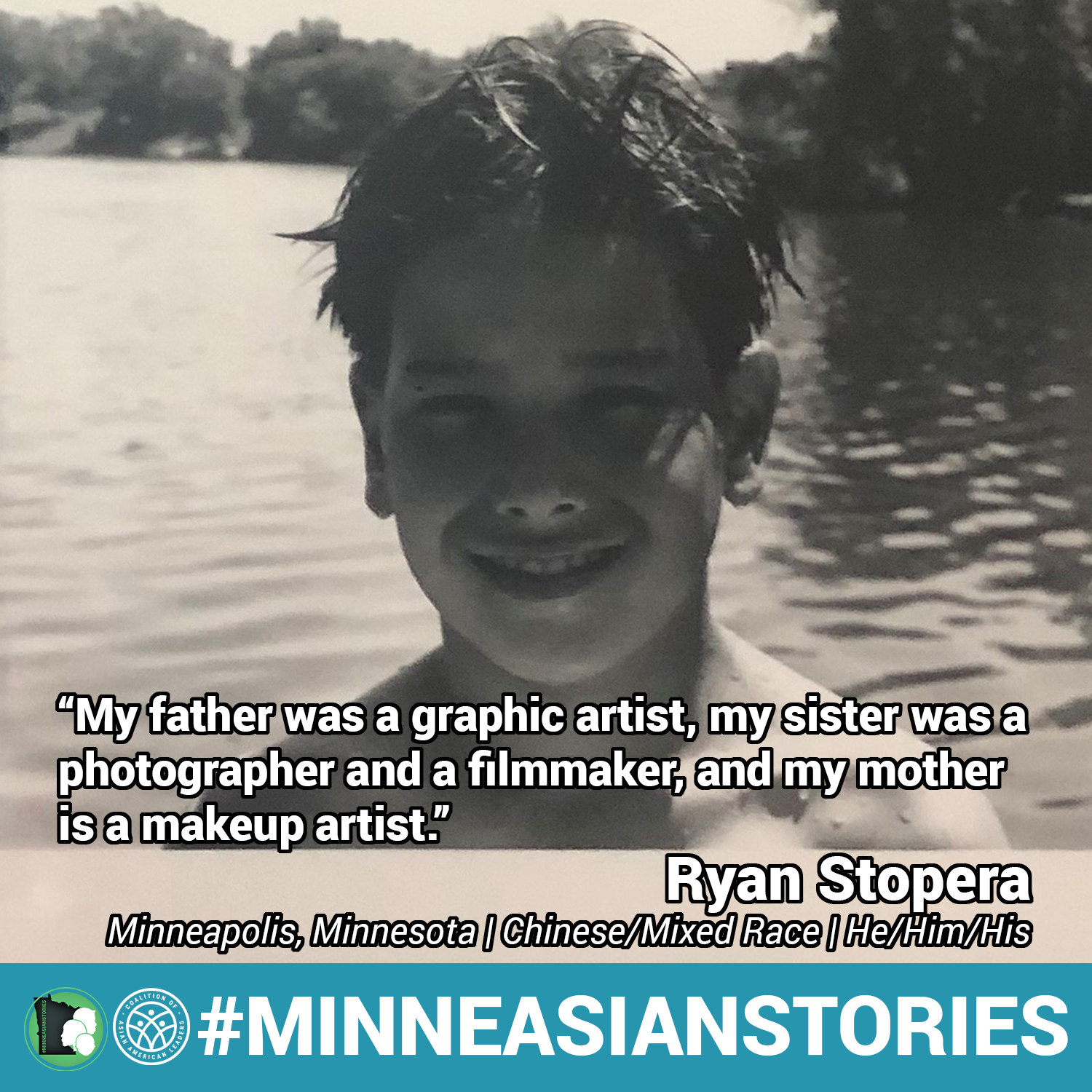
Until then I really hadn’t done much art even though all of my family members are artists. My father was a graphic artist, my sister was a photographer and a filmmaker, and my mother is a makeup artist. My whole family are artists. I guess I was the black sheep; until I fell into it.

The idea of making ACCENT as a book came from wanting to make something you could touch, feel, and flip through, or put on your coffee table and have a family conversation. I wanted something physical because everything visual today is on a 3 to 4 inch screen on your phone, and we don’t connect with it the way we do with something printed. And I knew I didn’t want to just make a bunch of prints, so I made a book. I wanted to connect with people like me. People that identify as Asian American, and to have conversations about what that means to us, because too often that conversation gets overlooked. So the best part of creating this book over the past year was talking to people in my community, connecting with friends, and making new friends.

Check out the rest of #MinneAsianStories.
Khamphiou Vang’s Story: Aim For The Skies

Npaus Baim Her

Saint Paul, Minnesota | Hmong | She/Her/Hers

A biography of Khamphiou Vang, my grandfather.

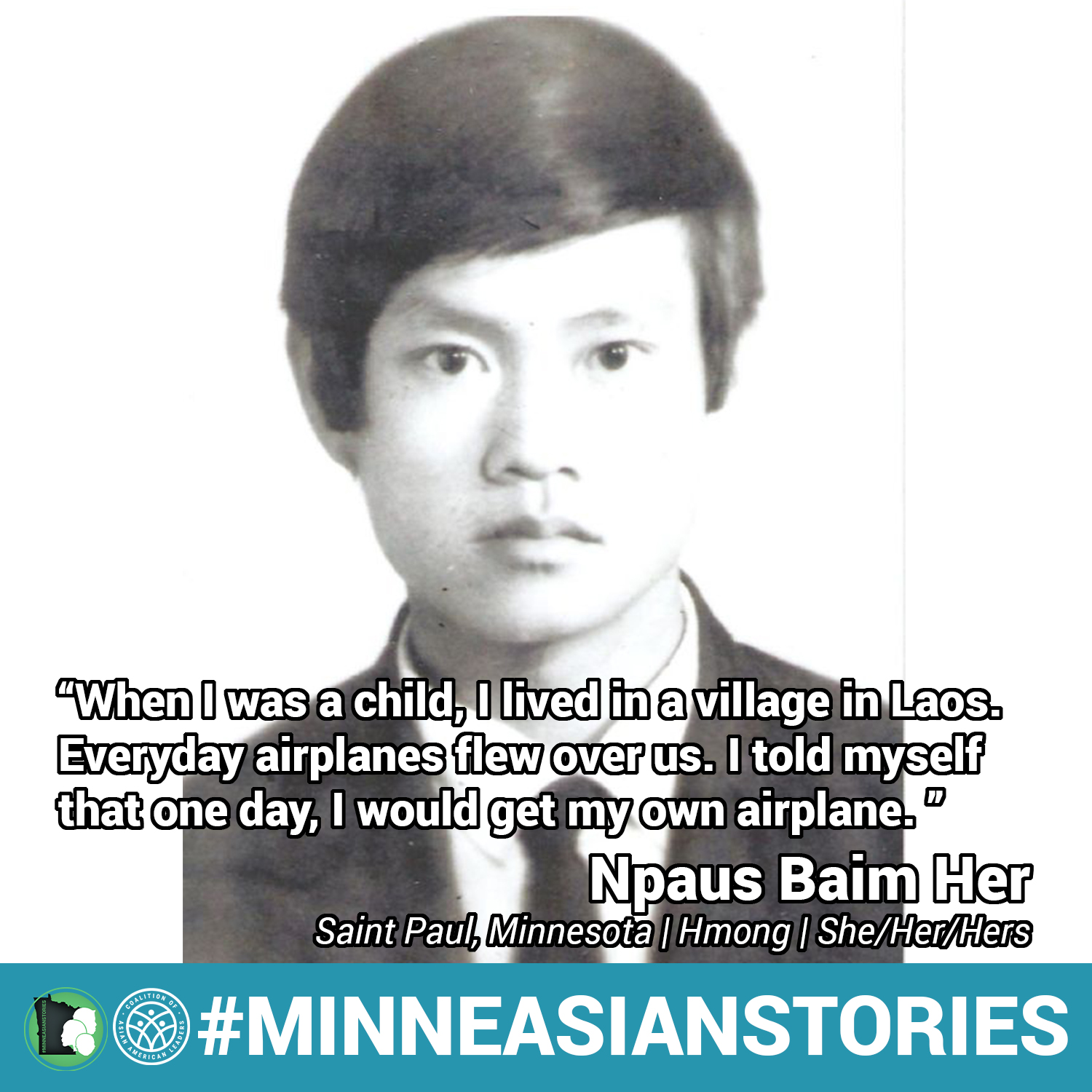
When I was a child, I lived in a village in Laos. Everyday airplanes flew over us. I told myself that one day, I would get my own airplane. I eventually surpassed that dream and owned two airplanes after coming to America – a Cherokee Six and a Piper Warrior II.

I am the second youngest child, so I couldn’t help on the farm as much, so my older brother sent me to a boarding school. In 1964, my village was attacked by communists, so my family fled to Long Cheng, then Vientiane.

I went back to school in third grade, but once I finished sixth grade, I realized that I wanted to get more education so I could earn a good income someday. My family no longer lived on a farm where we could raise crops and livestock so I knew I must go to school.

In high school, I was ranked the second top student. After graduation, I worked for the Lao Transportation Department and made 35,000 kip a month (that’s worth about $4 today). After four months, I left to work for a Lao Manufacturing company where I took care of packaging machines and made 55,000 kip per month (that’s about $6.50). I was still not making enough income to support myself. Finally, when I was promoted to a supervisor and had a salary of 80,000 kip per month, our country was taken over by the communists so I had to leave.

We didn’t have a choice to stay because my two older brothers were soldiers who fought against the communists. If they stayed, they would have been jailed. If I stayed, I would likely not be paid, or I would have lost my job because the communists do not like people who were part of the resistance.

In 1975, I crossed over the Mekong River to Thailand and made it to the refugee camps. I stayed there a year before being resettled in Minneapolis, Minnesota with my older brother and his family in 1976. We were the first Hmong refugee family to be resettled in Minnesota. The first family came as immigrants.

I was 21 years old at the time and wanted to pursue higher education. I worked hard for my dream and goals. I took English Second Language courses to prepare for college. I then went to an aviation tech school and received an airframe and powerplant certificate. Soon, I received my electrical and pilot license and worked at a small airport. I wanted to continue my career in aviation, so I went to the University of Minnesota – Twin Cities for four years. I could not finish my bachelor’s degree due to my family situation.

I was married with three children andr one more on the way. My wife worked a full time job to support the family while I worked part-time and went to school. In 1986, I landed a job with Northwest Airlines so I was able to work on airplanes. I enjoyed that so much. Eventually I was able to buy two aircrafts.

I’ve worked hard since the beginning. I had a dream and goals, and I strived to reach them. That has allowed me get to where I am today.

Check out the rest of #MinneAsianStories.
Finding Korea, Outside and Within

Nik Nadeau

Minneapolis, Minnesota | Korean | He/Him/His

I was born in Jinju, South Korea and adopted when I was 14 months-old. From that time, I spent most of my life in Hugo, Minnesota; just north of White Bear Lake. After college, I moved to Korea and taught high school English in Jeongeup, a “small” town nestled beside a mountain — famous for its maple leaves.

From 2010 to 2011, I lived in Seoul while working at Korea’s Fulbright headquarters. It was during that time that I was reunited with my Korean birth mother, who now lives in Daegu (Korea’s third-largest city), along with my uncles, who still live in Jinju.

I then moved back stateside—working in academic editing, children’s publishing and politics. In 2016, I decided it was time to move back to Korea for a while, to explore the possibility to living closer to my birth family. I stayed for about six months—learning a lot along the way—and eventually made the decision to move back to Minnesota. I’m really happy I did, but I don’t think a day goes by without missing Korea.

Over the course of my own journey, I’ve learned that sooner or later, most transracial adoptees have a racial awakening—an awareness that we are, in fact, not White. This is followed, sometimes days, sometimes years later, by a cultural identity crisis: a radical awareness that we are, in fact, Korean, Chinese, Guatemalan, or Ethiopian, etc.

Once that awareness and identity crisis really sinks in, there’s no going back. Suddenly, nothing else matters more than figuring out your Korean/Chinese/Guatemalan/Ethiopian/etc.-ness you have within. And if you don’t find enough of it inside yourself, you immediately go about searching for it outside yourself—by meeting people who can teach and most importantly help transform you into the complete, legitimate, and socially accepted Korean/etc. you now desperately want to become.

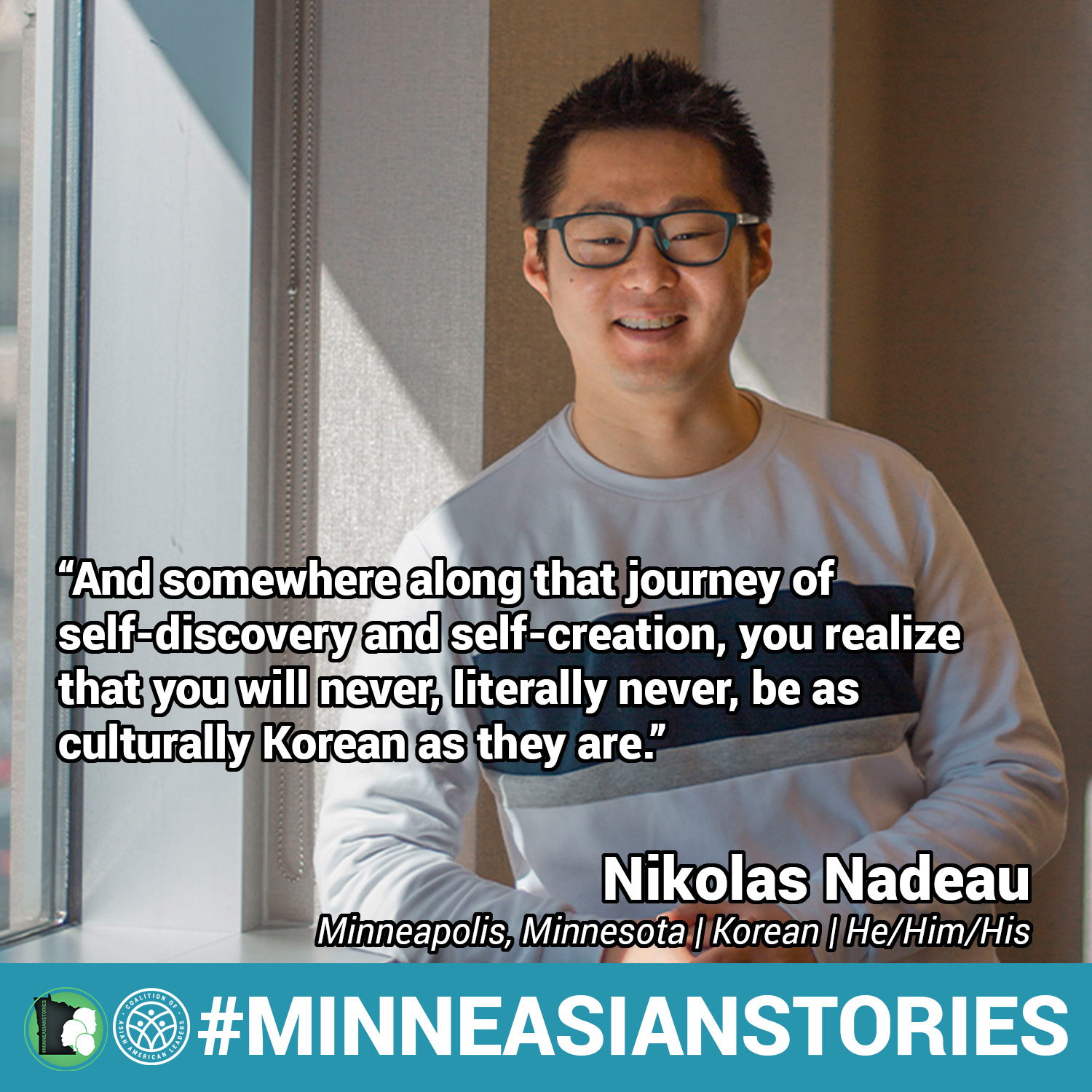
And somewhere along that journey of self-discovery and self-creation, you realize that you will never, literally never, be as culturally Korean/etc. as they are.

This truth is often quite devastating. It’s Cultural Identity Crisis Round Two—but this time, it’s a crisis not of self-discovery or self-creation, but self-acceptance. You learn that as hard as it is to create and re-create something, it’s even harder to accept what you create—and, like most creative endeavors—that the final product almost never turns out as you originally had imagined and hoped, and maybe even demanded it would.

But then, over time, you begin to see someone else taking shape—someone who’s not defined by how “X” you are, but by how brave and resilient and beautiful and worthy of love you are by trying to find out.

You discover a person you never knew could existand can’t help but admire. And you learn to love yourself, over and over again, even and especially when your failures are most evident.

Check out the rest of #MinneAsianStories.
Love Swallows Fear

Maykao Hang

Woodbury, Minnesota | Hmong | She/Her/Hers

Recurring nightmares turned out to be reality when I was in college. It was because I finally asked my mother why I woke up in tears about fire ants hurting my scalp, unquenchable hunger and thirst, and thick jungles that I couldn’t walk through. There was a cliff on my left and a man with a sharp knife, who wasn’t my dad, carrying me on his shoulders. In this nightmare, he would always slice a yellow gourd open and give me the refreshing juice inside. The sticky air would suffocate me and I would fall to the ground, and I would crawl flat on my belly to get away from the gunshots. I was never fast enough to get away, and would wake up in tears.

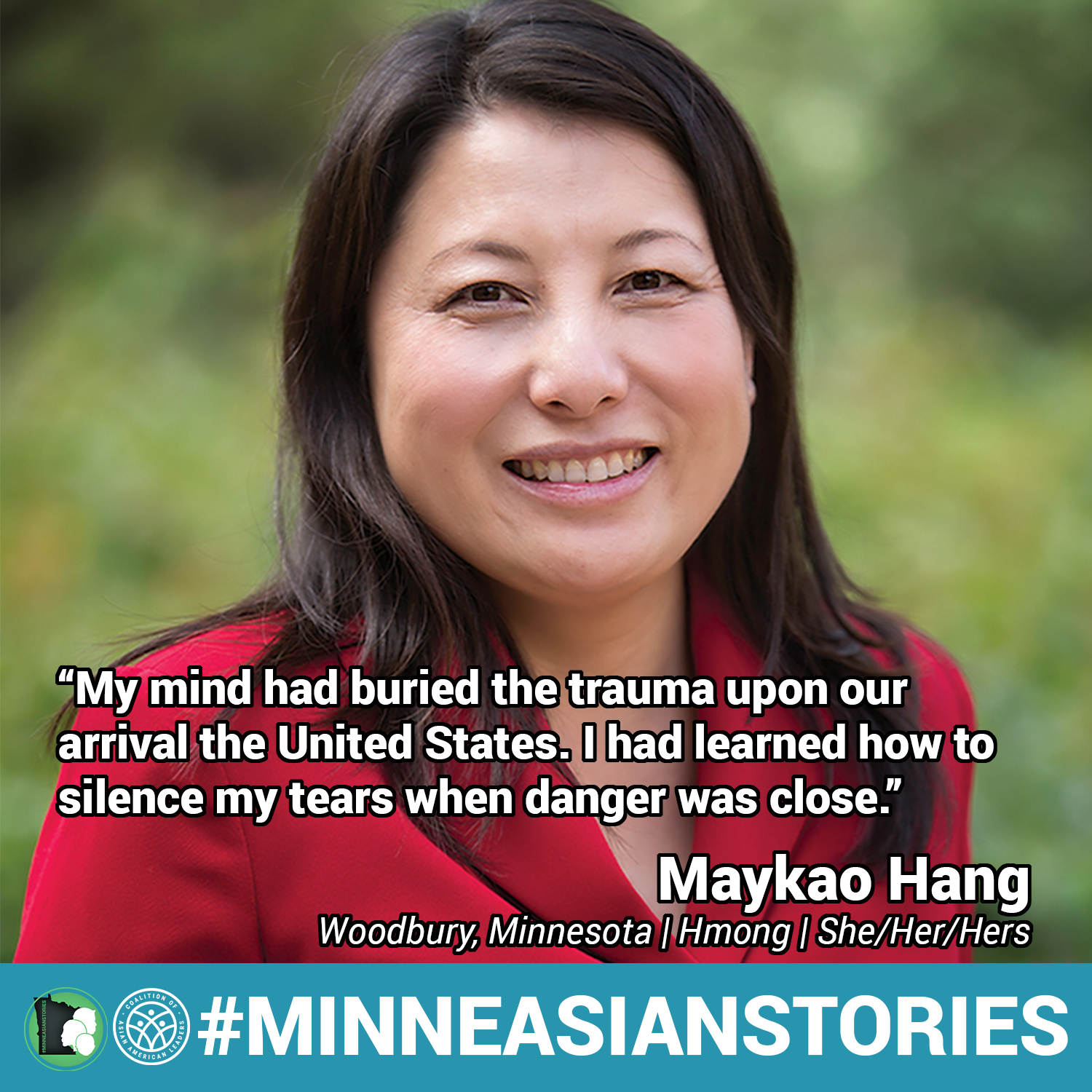
My mom told me that this was part of my actual refugee flight story when I was three. My mind had buried the trauma upon our arrival the United States. I had learned how to silence my tears when danger was close. The man with the knife turned out to be my uncle. He was killed after saving us. My dad had been thrown into a re-education camp and our family was saved by a village of lepers in that failed attempt to reach Thailand.

Genocide for the Hmong had come after the United State’s CIA left Laos, but we could not resettle because my dad had been a teacher and not a soldier. We lived in a refugee camp until I turned four. Growing up, my parents taught us to not let others decide our worth. My dad engraved this in my brain; that knowledge was the only thing others couldn’t take away. The grief and wounds in my childhood heart would not be undone, nor would the scars of hatred when strangers shouted for me to “go back home to your own country” on the sidewalks of St. Paul. But slowly, the love of those in my new country and community healed me.

The path out of poverty was difficult. I had just finished my third year at Brown University, when my mom told me the truth. I realized then that three family members probably died to get me out alive to be there. When college seemed insurmountable, I reminded myself that my older sister, May Song, walked from Laos to Thailand on her own small feet at the age of five. She survived because baby formula was dropped from the sky. My own life was saved by a dropper of expired Tylenol.

Adversity had made me strong. America is a nation of displaced people; and why it is a birthright in the Constitution if a child is born here. If your ancestors weren’t persecuted, indentured, imprisoned, enslaved, and came to this land, then you are likely an Indigenous person – the only real Americans. When I became President of the Wilder Foundation in 2010, I was surprised and humbled. I have incurable optimism, curiosity, and love for humanity. Today, whenever I am introduced as “Dr. MayKao Hang,” I smile because I have fulfilled the dream of my ancestors and my parents. Whenever a life improves, I am happy and satisfied. Whenever I am afraid, I remember that love can swallow fear.

Check out the rest of #MinneAsianStories.
Maddy’s World

Maddy Yang

Maplewood, Minnesota | Hmong | She/Her/Hers

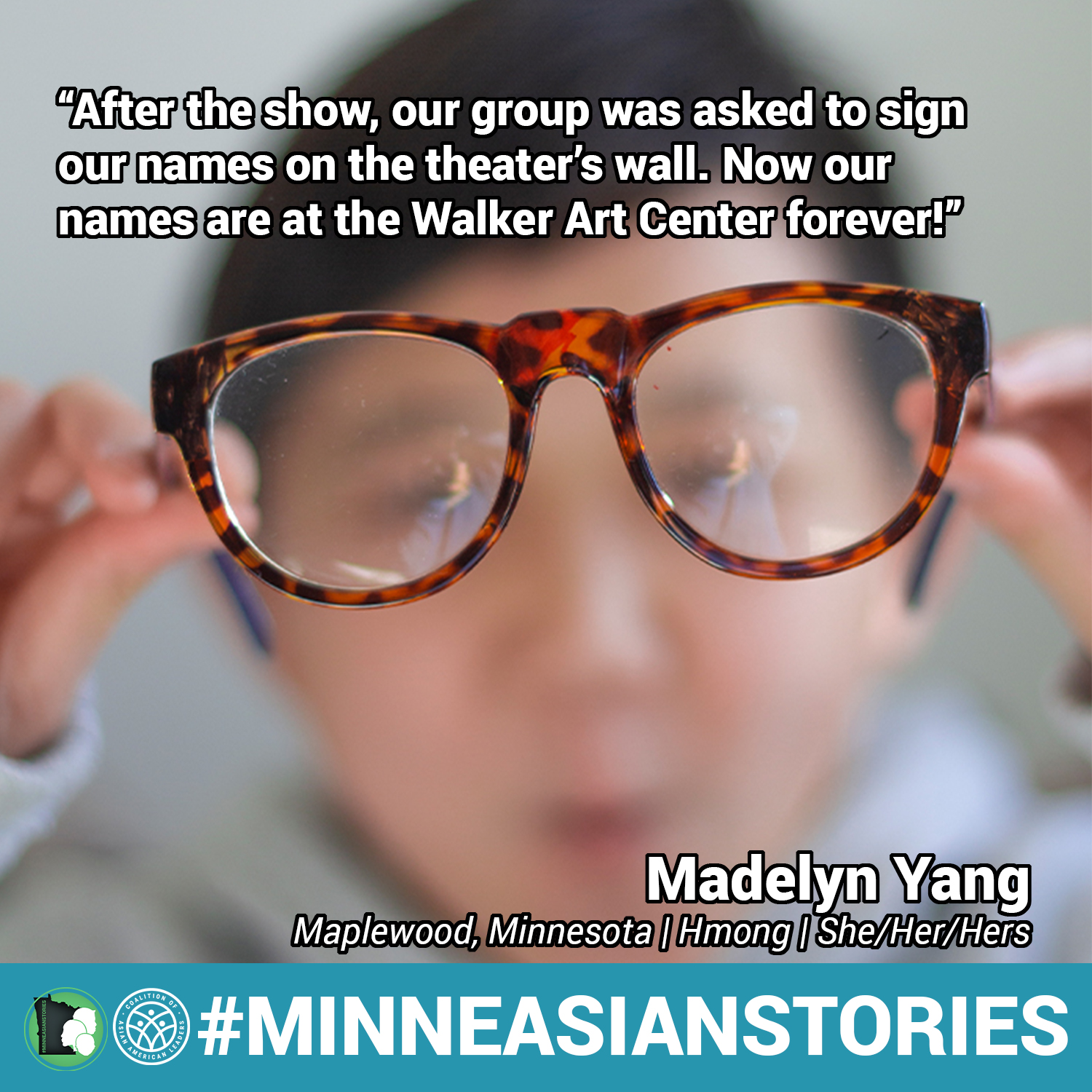
I am 12-years-old right now. My real name is Madelyn Yang, but a lot of people call me Maddy. I really love dancing and I can’t stop dancing. I’ve been dancing since I was little. One of my favorite memories was dancing at the Walker Art Center when I was nine years old. I made a lot of friends from this experience.

It started when I was asked by my dance teacher, Ms. Will, to perform with her group “I am from.” After learning the choreography and with lots of practice, I was ready to perform. There was 11 other dancers. We performed to a song about Black Lives Matter. The Walker Art Center liked our performance so we were invited to perform at one of their Choreographers’ evening events (at the McGuire Theater). Ms. Will had us practice as a group, added a few new dance moves, and then we performed in front of our friends, family, and strangers! I was so excited!

On the day of our performance at the Walker Art Center, it felt like I waited a very long time to get on stage. Maybe it was because I was too excited. My friends and I passed the time by sliding down a slide. The adults eventually told us to stop sliding, but then it was time to perform!

It was very fun performing! Everyone cheered and clapped. We even performed twice! After the show, our group was asked to sign our names on the theater’s wall. Now our names are at the Walker Art Center forever!

Check out the rest of #MinneAsianStories.
Returning Home

Lue Thao

Saint Paul, Minnesota | Hmong | He/Him/His

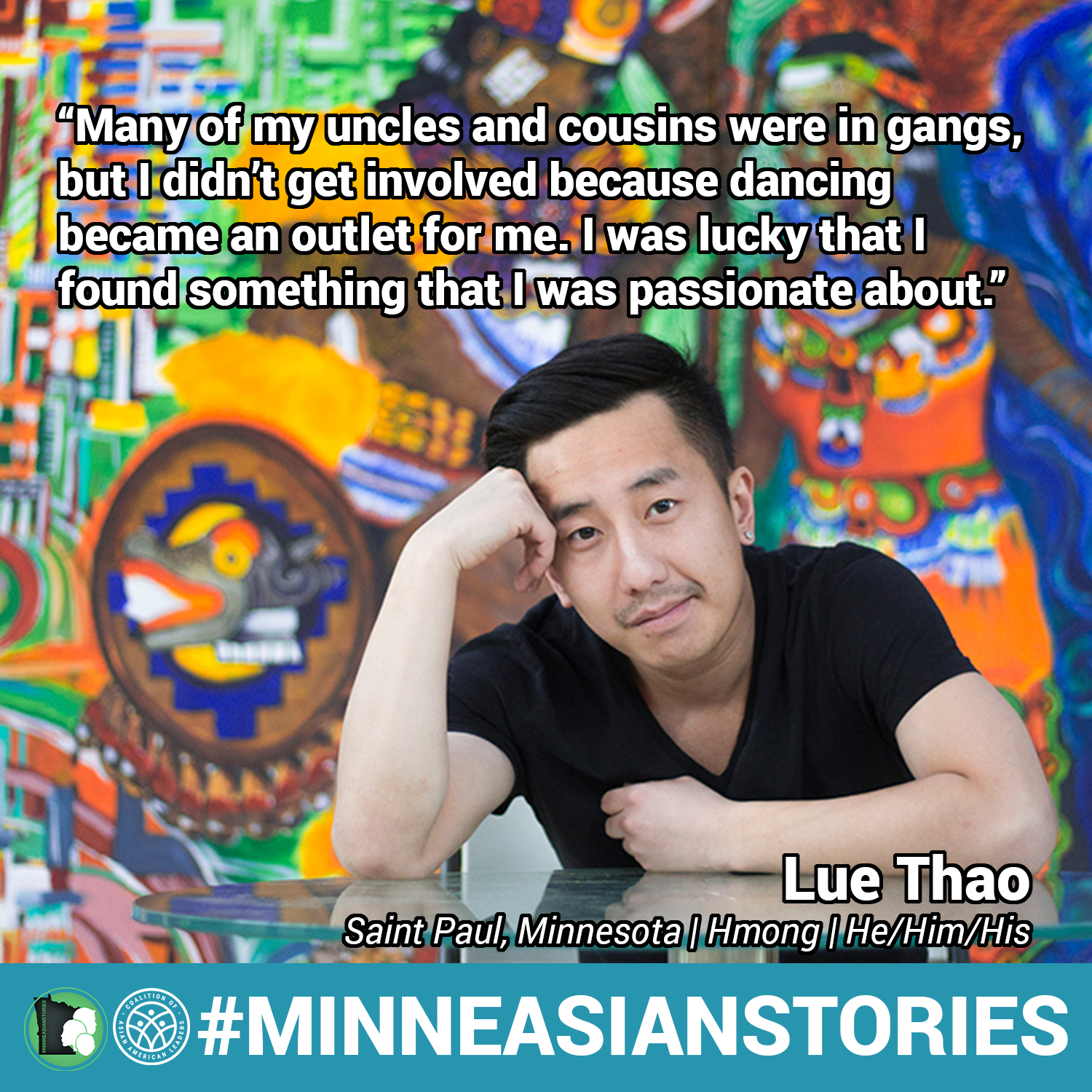
I was born in Thailand and came to the United States when I was 3-months-old. We lived in Frogtown at first – well, near Frogtown – in the housing projects. Many of my uncles and cousins were in gangs, but I didn’t get involved because dancing became an outlet for me. I was lucky that I found something that I was passionate about.

Almost three years ago, I went to Thailand with the project Street Stops and Mountain Tops – with Tou Saiko, Mai Yang, Keng, Dao, and Leedra. Our goal was to go teach hip hop, music, and the arts in Thailand. We wanted to teach at in an orphanage called Piyawat in Chiang Mai then go to Hmong villages to do workshops.

We went to Piyawat and introduced ourselves and put on a quick showcase of our talents. All the kids were very shy at first, but when we asked, “Who wants to do breakdancing with Lue?” A couple of hands raised.

With about 30 kids in the room we decided to just turn on the music. Then at least 10 more hands went up. The next day, 15 kids came to the class. I think they were shy but it didn’t mean they didn’t want to learn so we taught them.

I also had some connections to some Thailand Bboys so they voluntarily came to help teach the kids, too. Though we are all Hmong, I’m not the best at speaking Hmong and they weren’t the best at speaking Hmong either.hey are better with Thai – so we had some language barriers. But they came and taught. I was inspired because they came voluntarily and the kids had the opportunity to meet and see actual Thai dancers. The kids really loved it. We eventually went to the Hmong village where the orphans were originally from. We didn’t teach there, instead we listened.

We heard the stories of the kids and their families. In one case,their parents both remarried, and didn’t want to have to take care of him anymore so they gave him to their grandmother. The grandma was elderly and could barely take care of herself. So, she asked the orphanage to take him and they did. It was sad to see their living conditions. The grandma was loving and offered us food even though she didn’t have much. I’m a lot like her because that’s how I am too. I always give no matter how broke, sad, or low I am. I’m always a giver no matter what. It made me think: no matter where you are, you should always give instead of take. Some people take too much and don’t give. It was just great to go back to the homeland and see the living conditions where I was born. I eventually want to go back.

Check out the rest of #MinneAsianStories.
Parents Who Trade Their Lives For Yours

Al Tsai

Inver Grove Heights, Minnesota | Chinese | She/Her/Hers

With a few hundred dollars and a big dream for their children, my parents immigrated to the United States from Hong Kong when I was 5-years-old. My aunt was a student at the University of Minnesota, so between her and a local church, they sponsored my family, and we began our new life in pursuit of the American Dream.

My parents were extremely hard workers. For a while, they worked multiple jobs and received public assistance in order to make ends meet. Because I didn’t speak English I remember entering kindergarten completely confused. Fortunately, at age five, I spent close to a year in English as a Second Language (ESL) classes in the Minneapolis Public School system but picked up the language quickly. In the years following, we slowly climbed the economic ladder. My parents both worked assembly jobs, and with my father’s strong technical skills, he was able to gain more opportunities even with his limited language skills and lack of education credentials.

By the time I was in eighth grade, we were able to build a home and move to the suburb of Eden Prairie, Minnesota. I remember the great effort my mom undertook to help us integrate. I brought friends over and she would insist on making dishes like spaghetti even though that’s not what we normally ate. My parents would eat spaghetti with chopsticks.

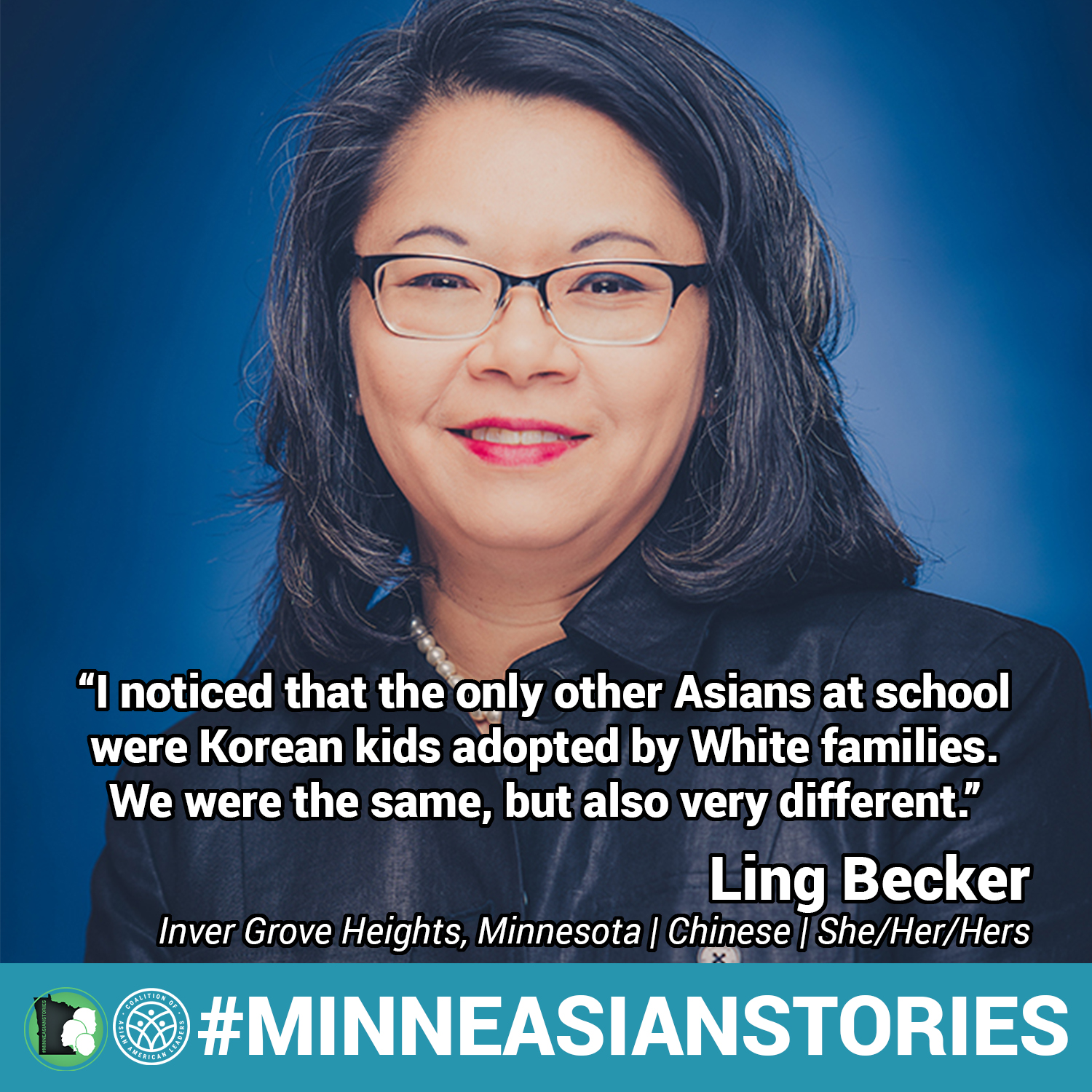
As a middle schooler, fitting was hard and there weren’t many other Asians at school. I noticed that the only other Asians at school were Korean kids adopted by White families. We were the same, but also very different.

My parents were completely dedicated to giving us a better life. They sacrificed everything for my sister and I.They often did little for themselves. They made sure we participated in sports, worked hard in school, and encouraged us to achieve as much as we possibility could. We both went on to obtain graduate degrees. My sister has a degree in occupational therapy, and I have a Masters in Public Administration from Syracuse University. I was a Woodrow Wilson fellow. That immigrant experience seems so distant to me now.

Today, I work in the economic development field where I help businesses grow and be drivers of economic vitality in communities. But, what good is economic prosperity and growth if it isn’t accessible by all groups within our society? I have come to realize that I have an opportunity and obligation to use my leadership role to ensure that all people have access to the same American dream. That dream that my parents believed in so strongly that it led them to trade their life for mine in many ways. I believe economic prosperity and growth can be accessible by all groups within our society.

Being in this field of work sometimes feels like eighth grade again when I was the only Asian kid in the room. I need to be confident in my role and abilities, and start fighting back against my hesitations, fears, and anxiety. I cannot be afraid of the unknown, possible failures, and setbacks. In order to fight back these insecurities, I have to dig deep emotionally. I try to imagine what it must have been like for my parents when they landed at the MSP airport. I can never thank them enough, but I am able to work as hard as they did to magnify others. I do this to demonstrate to them that their sacrifices were not only a dream come true for their daughters, but for all the people I impact too.

Check out the rest of #MinneAsianStories.
Buddhism and Me

Leah Htet

Shakopee, Minnesota | Burmese | She/Her/Hers

I was born in Burma (now Myanmar), in Southeast Asia. I lived there until I was 6-years-old. Then my immediate family – which includes me, my older sister, and my parents – moved to England where we lived until I was ten.

England has been one of my favorite places I’ve lived. In England it felt like my parents were so chill. I remember playing outside a lot. I’d be gone for hours playing with the neighbor kids, climbing trees, racing down hills, and exploring the woods. We lived on the hospital compound in Basingstoke because my dad was working at the hospital there. It seemed huge as a kid. In England I fell in love with soccer, biking and being outdoors.

We moved to the States when I was ten. We first lived in New York before coming to Minnesota. After some time in Minnesota, my parents moved to California. They have been staying warm since 2008 while I’ve remained here.

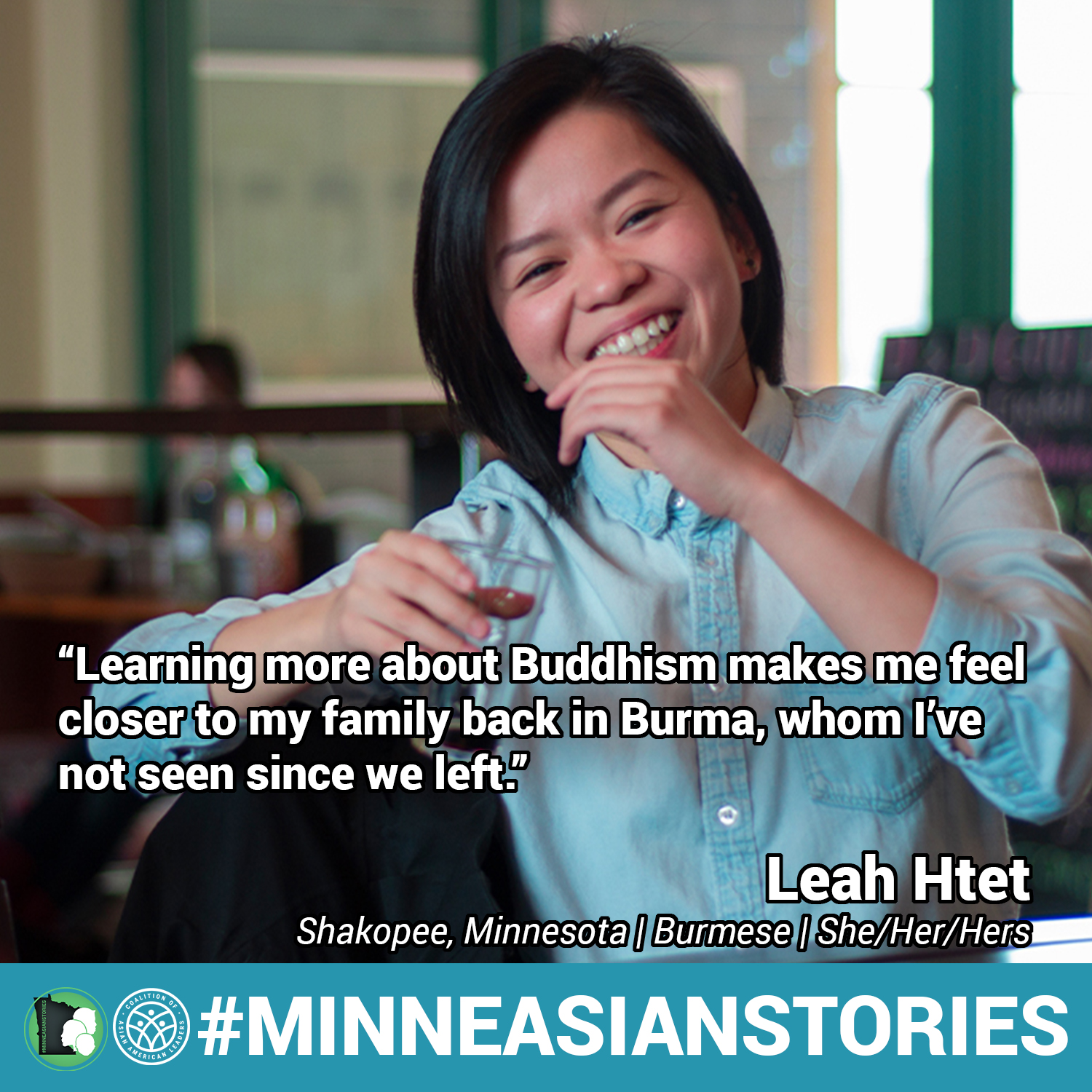
I don’t see my family as often as I’d like, especially my mom. Every time I visit, we end up visiting at least one monastery together. Though my entire family is Buddhist, I was never drawn to organized religion. But, as I have gotten older, I have come to realize how much Buddhism is a part of my identity, culture, and family. Learning more about Buddhism makes me feel closer to my family back in Burma, whom I’ve not seen since we left. We are a world apart but are connected through Buddhism. I’ve learned to appreciate the Buddhist philosophy and values.

Check out the rest of #MinneAsianStories.
Three Dates and 23 Years Later

Kunrath Lam

Saint Paul, Minnesota | Cambodian | She/Her/Hers

I was in my second year of college and he was a faculty member twelve years my senior. His coworker told him that the they had recently hired a new Thai lady. At the time, he was single so his coworker encouraged him to go meet the new Thai lady. When I entered the cafeteria, he asked me if I was Thai.

I said, “No, I’m Cambodian.”

He was born in Cambodia, but he’s ethnically Chinese so he didn’t speak any Cambodian. He spoke broken Cambodian and I made fun of him.

My family is very traditional; meaning that I never talked to boys or went on dates because that was not okay. After I met him, I tried to ignore him, but I saw him everywhere on campus. Whenever we ran into each other, I greeted him but then I’d avoid those locations, fearing I’d run into him again. I even went so far as to stay in my dorm room to avoid seeing him. I told myself I couldn’t talk to this guy because if my parents knew, they would lose their reputation in our community.

After a few months of avoiding him, I walked out of my dorm room and there he was, standing in the lobby. He asked me if I’d like to hangout with a group of mutual friends. I didn’t know what to do other than question, “Why would you want to go out with me?”

I agreed to go, but I was so nervous I canceled at the last moment. He had our friends ask me, so I went. I never went out with him alone. We were always with a big group when we did go out.

I explained my parents to him, and told him to ask my parents for permission if he wanted us to go out alone. He had his parents come to talk to my parents. We went out exactly three times before we got married.

When he asked my parents for their approval to marry me, they looked at both of our ages and zodiac signs and found that we were a match. My father even had a dream that my grandma told him that it was okay to let us marry.

Our cultures collided when it came to marriage. In the Cambodian culture, the husband is expected to pay for the wedding and to join his wife’s family so he can care for them. In the Chinese culture, I was expected to become a part of his family. In the end I said, “We are Cambodian.” He agreed.

I prayed so hard to Buddha while we were engaged, because I didn’t know him well. I prayed for him to be the right person. Now we’ve been married for 23 years and have three beautiful children. In those 23 years, he learned Cambodian but I still don’t speak any Chinese.

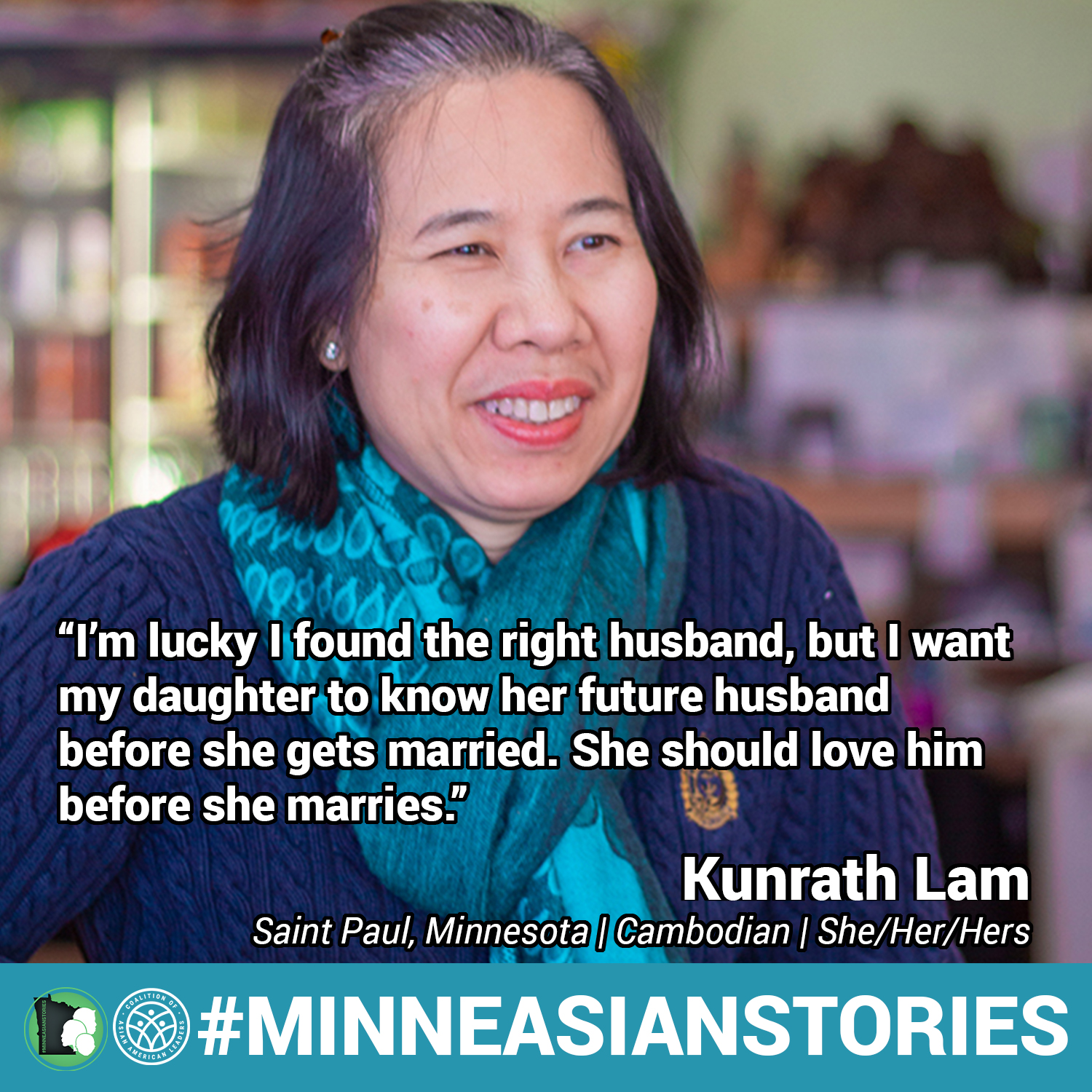
Now I don’t want my children to be like me. I’m lucky I found the right husband, but I want my daughter to know her future husband before she gets married. She should love him before she marries.

Check out the rest of #MinneAsianStories.
The Bus That Changed My Home

Kao Choua Vue

Emeryville, California | Hmong | She/Her/Hers

I met Pete Kane on Tinder in February 2015. We frequently hung out. Eventually he introduced me to Nick Powley, whom he met at the Hackers and Founders group on Meetup. I needed a place to stay and Nick had an open room. I lived with him and Simon, another roommate. A few months later, I was laid off. I collected a few personal items from my work desk and headed out of the office. I was told I could work for the remainder of the week if I wanted to say my goodbyes, but my heart was heavy and I couldn’t get out of bed.

Pete had been looking on Craigslist and saw retired yet functional Metro Transit buses being sold for $3,500. Pete asked, “Will you go in half of the cost of the bus? Since you don’t have a job anymore, we can take it on the road.” Having just received my severance check I said, “Okay.”

We drove to St. Cloud with a couple of friends and made a swift decision to purchase it. The gas tank was filled with about 150 gallons of diesel, and burned at 4 miles per gallon. I couldn’t wait to gut the 1999 Gillig bus and convert it to an RV.

We borrowed tools from my roommate Nick to dismantle all the seats. Almost half of the metal framed seats were rusted on the bottom. We laid the metal framed seats, seat cushions, and metal bar handles on the front lawn of Nick’s house on Burns Avenue in St. Paul. At last, after several weeks, all of the seats were finally removed. It took many buckets of water and rags to wipe the dirt from that 15 year old bus. We went over each area at least a dozen times before there were any signs of progress.

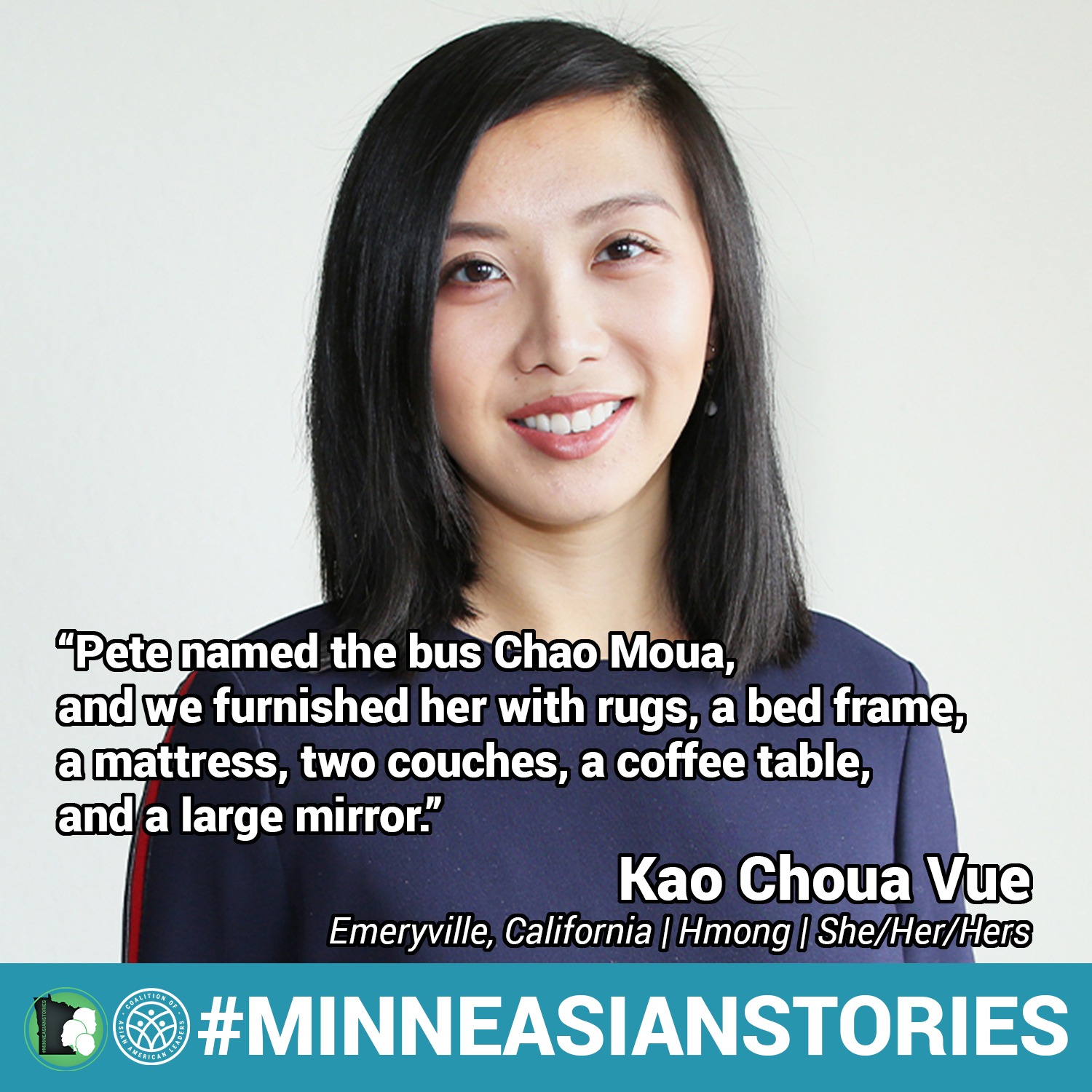
Pete named the bus Chao Moua, and we furnished her with rugs, a bed frame, a mattress, two couches, a coffee table, and a large mirror. We parked Chao Moua outside of Pete’s parents’ house in West St. Paul for two weeks, which annoyed the neighbors. Pete’s father had all the tools we needed to complete the project. I custom built two benches to cover the front wheel wells and taped the edges of the windows to prep the exterior body for the spray paint. Pete and his father built the back shelves and seats and spray painted the exterior.

“Let’s take Chao Moua to the Bay Area and live on the bus,” Pete said. He wanted to be close to the startup scene there. I, on the other hand, had no interest or any connections to that area, but I caved in. I had invested more than half of my savings into the bus already so why not. In the end, I packed up my suitcase and we headed off. I told my parents I was going on a road trip to California. Little did everyone know, I would make the Bay Area my new home.

Check out the rest of #MinneAsianStories.