Southeast Asian American and Asian American Organizations Across the Country Denounce Trump Administration’s Move to Increase Deportations to Laos: PRESS RELEASE

Message from Bo Thao-Urabe, Executive and Network Director (CAAL):

Because deportation has numerous detrimental impacts on individuals who are deported, and on the families and communities they are forced to leave behind, CAAL along with our partners across the country stand firm in our position that immigrants and refugees should not be deported without due process and human rights considerations. Please read our statement to community on the latest efforts by the Trump Administration to deport Hmong, Lao and other immigrants and refugees who have heritage to Laos.

If you are impacted there is help. If you want to help advocate on this issue there is a network you can participate in. Together we must build from the work of our Vietnamese and Khmer communities to demand just change, and ensure our government is working to protect us, not tear us apart.
FOR IMMEDIATE RELEASE:


February 7, 2020

Southeast Asian American and Asian American Organizations Across the Country Denounce Trump Administration’s Move to Increase Deportations to Laos
Hmong/Lao Americans with Removal Orders Should Seek Legal Assistance

WASHINGTON, DC – We learned that in 2019 the U.S. State Department (DOS), Department of Homeland Security (DHS) and the Government of Laos (GoL) made a verbal agreement to deport a significant number of individuals annually with final removal orders to Laos. While there is currently no formal deportation memorandum of understanding between the United States and Laos, this verbal agreement makes those with final orders for deportation potentially more vulnerable to removal by the Trump Administration.

Moreover, the U.S. DOS recently confirmed that the U.S. Agency for International Development (USAID) is funding a reintegration program in Laos for deported individuals who do not speak t Lao or have family connections — an indication that even former refugees with no ties to Laos will be included in this annual deportation goal. Since 1998, the United States has deported 219 individuals to Laos, and in 2019, five individuals were deported. Currently, about 4,500 Hmong/Laotian individuals living in the U.S. have a final order of removal.
Below is a statement from the Southeast Asian Deportation Defense Network:

“We reject the continued deportations of immigrants and refugees without regard for human rights and due process. We condemn efforts by the United States government to continue deporting Southeast Asian Americans, many of whom are former refugees. We fundamentally believe that regardless of past mistakes, everyone must be given the opportunity, resources, and support networks to turn their lives around and become productive citizens. We believe in transformation and know that many individuals are pivotal members in their local communities. They must be afforded the same due process rights as every other American.

Those who are targeted now have served their time and should not face a lifetime sentence by being deported. We have learned from decades of work with our Cambodian and Vietnamese communities that we must not give up and can stop deportation cases through partnership with advocacy and legal organizations. We urge impacted families to seek legal assistance with experienced and trusted immigration and criminal defense attorneys. We also ask that individuals and organizations who want to effectively organize and advocate on this issue join us.”

Below are organizations with experience serving and advocating on this issue. The services provided by these groups are especially focused on assistance to gain relief from detention and deportations; while advocacy work focuses on stopping the deportation of this group of people through policy changes. Individuals facing deportation to Cambodia, Laos, or Vietnam can also access the Southeast Asian Raids website for additional resources, or call (415) 952-0413 for free legal advice.

For those in our community who are impacted, we urge you to take the following steps to protect you and your families:
1) All individuals who currently live in the U.S. with deportation orders to Laos should contact organizations in your state or the regions closest to you for assistance.
2) All individuals who are green card holders who are facing criminal convictions should talk to their lawyer about deportation consequences.
3) Those seeking advocacy support for detentions and deportations can also access this resistance toolkit.


Please reach out to these organizations for more support:

California:
• Asian Americans Advancing Justice – ALC, Anoop Prasad, anoopp@advancingjustice-alc.org
• Asian Prisoner Support Committee, Nate Tan, nate@asianprisonersupport.org
• Fresno Interdenominational Refugee Ministries, Lucky Siphongsay, lucky@firminc.org
• Hmong Innovating Politics, Nkauj Iab Yang, nkaujiab.yang@hipcalifornia.com

Georgia
• Asian Americans Advancing Justice – Atlanta, Phi Nguyen, pnguyen@advancingjustice-atlanta.org

Massachusetts
• Asian American Resource Workshop, Kevin Lam, kevin@aarw.org
• Greater Boston Legal Services – Asian Outreach Unit, Bethany Li, bli@gbls.org

Minnesota:
• Coalition of Asian American Leaders, KaYing Yang, kaying@caalmn.org
• Lao Assistance Center of Minnesota, Sunny Chanthanouvong, sunny@laocenter.org
• Release MN8, Montha Chum, montha@releasemn8.org

New York
• Mekong NYC, Chhaya Chhoum, chhaya@mekongnyc.org
• Southeast Asian Defense Project, Socheatta Meng, smeng@seadefense.org

North Carolina:
• Southeast Asian Coalition, Ong Vang, ong@seacvillage.org

Pennsylvania:
• Laos in the House, Catzie V., catziev@gmail.com
• VietLead, Nancy Nguyen, nancy.nguyen@vietlead.org

Washington:
• Khmer Anti-Deportation Advocacy Group, Sina Sam, khaagwa@gmail.com

Wisconsin:
• Freedom, Inc., Kabzuag Vaj, kabvaj@freedom-inc.org

National:
• Laotian American National Alliance, Jonathan Vorasane, jonathan@lana-usa.org
• Southeast Asia Resource Action Center, Kham S. Moua, kham@searac.org
• Southeast Asian Freedom Network, June Kuoch, june@seafn.net

About the Southeast Asian Deportation Defense Network

The Southeast Asian Deportation Defense Network is a national collective of Asian American organizations focused on preventing the detention and deportation of Southeast Asian refugees, and reuniting deported loved ones with their families in the United States. Member organizations include advocacy, grassroots, and legal organizations with over two decades of experience in deportation defense work.

For more information, please contact:

KaYing Yang, CAAL, kaying@caalmn.org / 651-756-7210
Kabzaug Vaj, Freedom, Inc., kabvaj@freedom-inc.org / 608-217-7754
Vimala Phongsavanh, LANA, vimala@lana-usa.org / 401-378-1949
Kham S. Moua, SEARAC, kham@searac.org / 612-465-9539
February 2020 – Staff Corner

It’s been a long journey of unlearning and relearning how to step into my leadership and take up my rightful space in this world.

My childhood and education experiences were filled with constant messages and reminders that the terms “Asian American”, “womxn”, and “leader” don’t belong together. From being called “the quiet Asian girl from Pitch Perfect” to having teachers who reinforced my quietness as standard for students of color, I grew up thinking I wasn’t destined for greatness – that my voice is insignificant.

In sophomore year of high school, my homeroom was voting for student council members. Across from me sat two white students. I saw that one began carelessly crossing out names. His  friend asked, “Why are you crossing out their names?” He answered, “Oh, I am just crossing out the Asian names.” They both looked at each other and laughed out loud.

I was horrified but deep down inside I understood where those boys were coming from. They, like me, had over 10 years of formal education where none of us had never read, seen, or studied a positive Asian person in our curriculum. I realized that the two white male students were merely a reflection of our broken, inequitable, and exclusionary education system. 

In those 10+ years of formal education, all my ambitions, passion, and voice were constantly erased, and my identity didn’t matter. What happened in homeroom that day struck me. It motivated me to explore and define what being an Asian American womxn meant to me. I began to embrace my various identities – Asian American, womxn of color, child of refugees – and embraced them as assets. I began to think of them as the foundation for how my leadership could show up in the world. It was the beginnings of an important shift.

When I graduated from the University of Minnesota in 2017, I discovered the Coalition of Asian American Leaders (CAAL). I loved seeing the terms “Asian American” and “leader” together in a sentence, and it felt like a happy ending to my high school chapter. I feel grounded at CAAL, knowing that everyone who enters our network is already seen a leader regardless of their titles. They each bring important assets, experiences, and expertise into the network. They bring their full selves, and that is enough to build from. This resonated so much with my own leadership philosophy. I always knew in my heart, but doubted it’s validity because of my experiences growing up.

It’s been almost 10 years since I started high school. Now when I have conversations with Asian American youth, they share similar leadership and identity challenges – they name the persistance of racism. It is heartbreaking hearing that they feel exactly the same way that I did in high school. Not much has changed.

I believe young people deserve better and they can indeed take up leadership to help end historic systemic practics of erasure, denial, and exclusion. So, as 2019 came to a close young Asian Minnesotans co-created Becoming Organizers, Becoming Advocates (BOBA) with CAAL. BOBA invites youth to unapologetically celebrate and honor who they are, and supports and builds them to show up as their most authentic and brilliant selves. Young people don’t have to wait to be leaders; they are leaders today.

Powering Up for 2020: PRESS RELEASE

November 16, 2019, St. Paul, MN – The Coalition of Asian American Leaders (CAAL) will host the first Asian Minnesotan Leadership Summit: Powering Up for 2020 on Saturday, December 7, 2019, at Metropolitan State University to lift up and bolster community leadership, organizing, and mobilization efforts in Minnesota’s Asian American communities. Given major political elections and activities, such as the U.S. Census, CAAL feels it needs to help ensure every community is aware, empowered, and supported to exercise their civic duties.

“There is a lot happening in our cities, state, and country at this time. More than ever, our leadership – how we exercise our power and influence, grow our connections, knowledge, and skills, and support our communities to participate in civic processes – will be critical to our democracy,” explains Bo Thao-Urabe, CAAL Executive and Network Director.

At the day-long Summit, 250 Asian Minnesotan leaders from across the state will have opportunities to connect with one another, learn new skills for mobilizing and organizing people, gain new knowledge about key issues impacting the community, and identify where Asian Minnesotans can increase civic engagement in order to shape democracy at historic levels in 2020. Some planned workshop topics include: the importance of census participation, understanding election cycles and structures that enable communities to fully participate in elections, how to effectively advocate for issues at different levels of government, and being your most powerful self as a leader.

Nationally-renowned author and activist Helen Zia will deliver a keynote address about what civic engagement in 2020 must mean for Asian Americans as one of the fastest-growing racial groups. Other confirmed speakers so far include State Representative Samantha Vang and former State Senator Satveer Chaudhary; other speakers will be announced soon.
To learn more about the Leadership Summit, visit: http://caalmn.org/poweringupfor2020/
###
About Coalition of Asian American Leaders – The Coalition of Asian American Leaders (CAAL) is a multi-ethnic, multi-sector, and multigenerational network of more than 2,000 Asian Minnesotan leaders harnessing collective power to improve the lives of community by connecting, learning, and acting together.
To learn more about CAAL, please visit www.caalmn.org.
Powering Up for 2020 Press release

Spark Leadership Fund: PRESS RELEASE

Spark Leadership Fund Recipients Announced

15 Asian American Leaders within Minnesota receive funding for their Leadership

Contact:
Bo Thao-Urabe – bo@caalmn.org | (612) 208-7226 (or)
Brian Kao – brian@caalmn.org | (612) 524-9694

The Coalition of Asian American Leaders (CAAL) will announce 15 Asian Minnesota leaders as the recipients of the Spark Leadership Fund and will present selected leaders with awards of $1,000 each. The Spark Leadership fund aims to support each leader’s project-related expenses and activities that would strengthen and grow an individual’s skills/experiences to achieve a leadership goal.
Montha Chum, one of the selected leaders, stated that she would use the funds support the development the newly-founded organization ReleaseMN8 to fight against unjust family separations and deportation in Minnesota and across the country. Asma Mohammed will use the funds to help pay for travel costs to attend culturally-relevant training regarding sexual assault and healing.
Mohammed stated, “My goal is to use these funds to invest in my own understanding of trauma around sexual violence and learn how to support survivors in my community better while taking care of myself. I know that connecting with others who are doing this work is crucial to me feeling less alone.”
Other supported projects and activities include creating a 26-episode podcast series to help elevate Asian Minnesotan stories, publishing a memoir manuscript written for 1.5 and 2nd generation refugees, and paying for training and educational programs. A full list of award recipients and a brief description of each leader’s activity or project is attached.
The announcement will coincide with CAAL’s Asian Pacific American Heritage Month kickoff event at the Minnesota State Capitol. The event will be held at the State Capitol Rotunda on May 6, 2019 from 10 a.m. – 12 p.m. Mayor Frey, Governor Walz, House Speaker Hortman, Representative Samantha Vang and members of Minnesota Asian Pacific (MAP) Caucus, and other legislators will join the celebration. This event is open to the public. Community members are invited to attend and can RSVP here.
WHEN: Monday, May 6, 2019 from 10:30 am to 12:00 pm

WHERE: Minnesota State Capitol Rotunda

###

About Coalition of Asian American Leaders

The Coalition of Asian American Leaders (CAAL) is a nonprofit network of more than 2,400 Asian Minnesotan leaders who are harnessing our collective power to improve the lives of community by connecting, learning, and acting together. To learn more please visit www.caalmn.org.

About SPARK Leadership Fund

The SPARK Leadership Fund offers financial support to Asian Minnesotan Leaders within the Coalition of Asian American Leader’s network. Individual leaders can apply for funds of $500, $750 or $1,000 to support their own growth or to fund a project idea. To learn more please visit www.caalmn.org/spark/.

Redbone from Luzon: Home is a Feeling

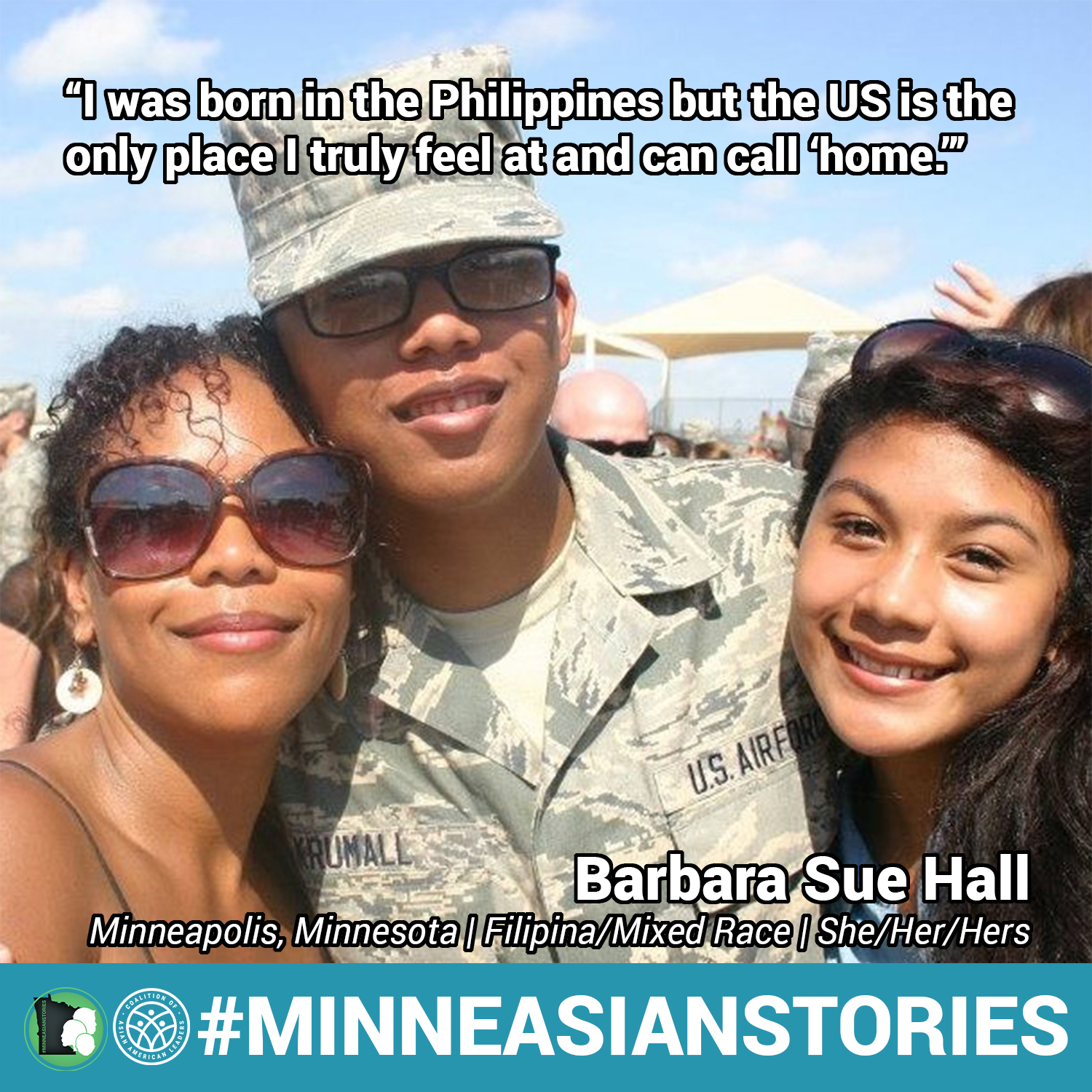
Barbara Sue Hall

Minneapolis, Minnesota | Filipina/Mixed Race | She/Her/Hers

Redbone: “Redbone is a term historically used in much of the southern United States to denote a multiracial individual or culture.” (Wikipedia)

I am a 51 year old African American/Filipina “Redbone” Navy brat born in Olongapo City on Luzon, the most northern island in the Philippines (PI). I spent my first 15 years of life in Japan, CA, FL, and Hawaii. My father, an African American “Redbone” from the Southeastern US, was stationed in the PI during the Vietnam War where he met my mother, a Filipina from Manila.

When I was 15, we moved back to the Subic Bay Naval Base, next to Olongapo where I had lived until I was 4. We resided in base housing surrounded by a jungle of majestic trees, monkeys, bats, flying squirrels, boars, and snakes. Our backyard was the ancestral homelands of the Aeta, an indigenous Afro-Asiatic people who continue to be discriminated against for their darker skin and “kinky” hair.

I lived there for 3 years, attending the base high school; touring the country; dancing at clubs; and counting my blessings that I wasn’t one of the many Olongapo prostitutes my age. Olongapo was a designated R&R (Rest and Recreation) zone during the Vietnam War and prostitution remains legal there. The city’s main street is still filled with clubs where Filipinas are employed to “entertain.”

Because of the biases against darker skinned people, very few businesses, overall, were then and are now willing to employ Black AmerAsians, even those catering to African Americans. Women who look like me are often relegated to “street walking.” When off base, I was frequently and disdainfully asked by the town police for my “walking papers” – documents required to “legally” street prostitute. They were usually surprised and sometimes expressed envy that I was “American” because, I believe, I challenged the accepted social order – the established color and class hierarchy – as one of the few Black AmerAsians with married parents; “base privileges;” and all the benefits of US citizenship.

At 18, I had the option to give up that citizenship and be a “Philippine National.” After years of witnessing blatant racism against Black AmerAsians and Aeta people, I had no desire to give up my “American” identity. Despite the atrocities committed against my father’s African and Native ancestors by this country, I still had far greater opportunities here to be educated, build a career, travel, and enjoy the freedoms which those ancestors – over the past 400 years – lost everything but their souls for me to have.

I graduated high school and left the comfort of my “gated” military base community alone on an Air Force Tiger 747 for California to start college. I was idealistic and sheltered from the racism and other realities of being a “Redbone” woman in the US. But regardless of those realities, I will ALWAYS choose to be “American.” I was born in the Philippines but the US is the only place I truly feel at and can call “home.”

Check out the rest of #MinneAsianStories.

We Make Any Place Home

Yusanat Tway

Saint Paul, Minnesota | Karen | She/Her/Hers

I was six years old when my parents told me about America: a land with big houses that contained separate bedrooms and this thing that stored food, which I later found out was called a refrigerator. In September 2007, my family immigrated from Thai refugee camps to Minnesota. We rented a house in Saint Paul; three floors, three bedrooms, and one bathroom. I had five brothers and two sisters, which meant I did not get my own room. What a relief! My six year old self was scared at the thought of having to sleep in my own room.

In the refugee camps, I always slept surrounded by the security of my siblings. On the first night we moved into our Saint Paul rental, my whole family woke up at two in the morning, because our bodies had yet to adjust from moving across the globe. It was then when I finally realized that I no longer had to wake up and tend to the domestic animals or stay up late to do homework with a candle. Home now had running water, electricity, gas stoves, and all I had to worry about was my education. This was my new home and I knew we were going to live here for a very long time.

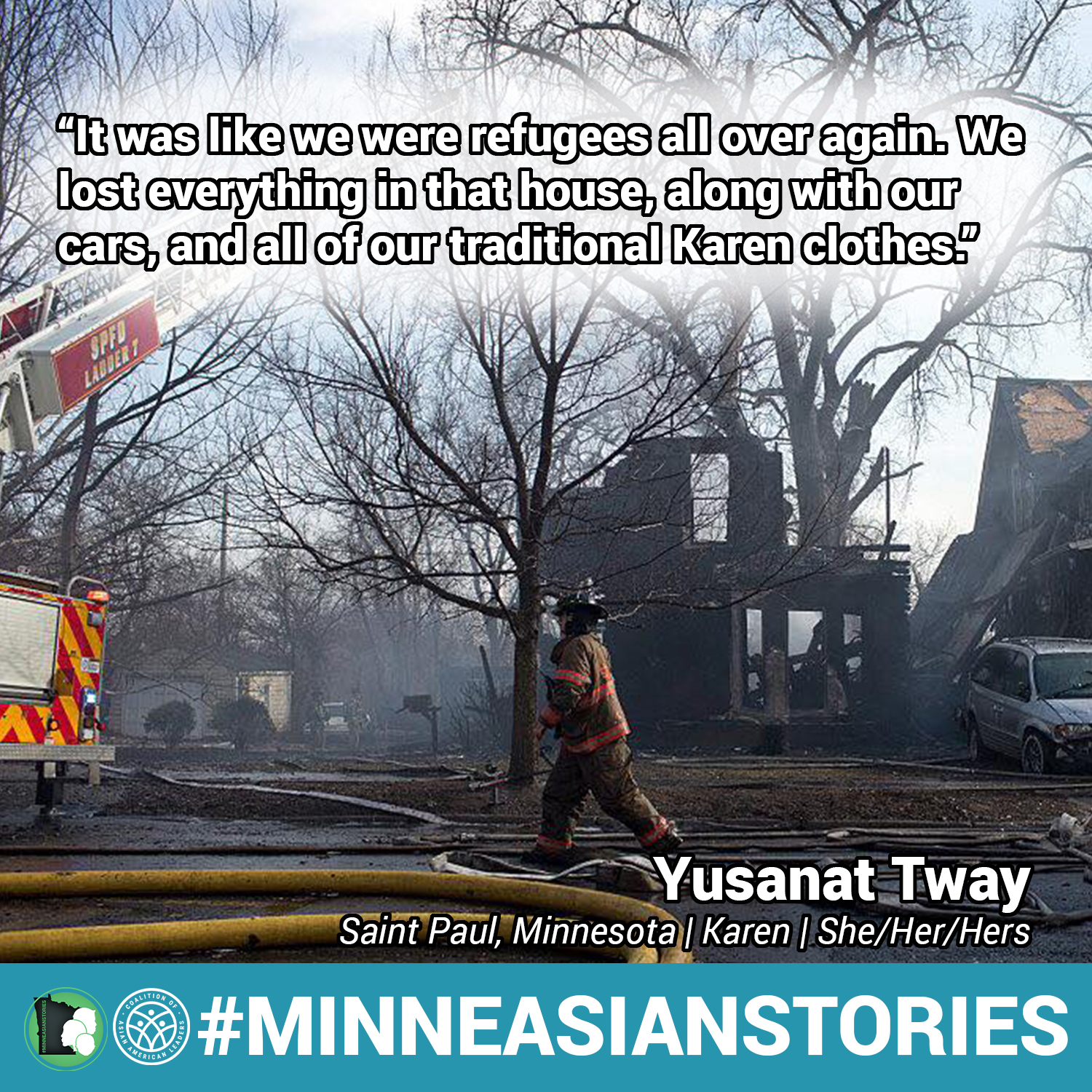
On April 1st, 2015, I was hanging out with my best friend, when I started receiving texts from my cousin: “Is it true that your house is on fire?” My brother texted me, “Are you guys all okay? I’m on my way back from college.” I texted back to them, “I know it’s April Fool’s day, you won’t get me!” I was really thinking that they were all trying to trick me. I kept receiving texts from other relatives and friends. Finally, I checked the news and my house was surrounded by fire trucks.

My neighborhood was on fire. As soon as I saw my mom on the screen, I ran straight home. That was the fastest I ever ran in my whole life. The fire started from a branch that fell on an electric power line which lit the house next door on fire to complete ashes. The fire then flew over to our house, then my friend’s house, and finally across the street. I remember my dad sighing in disbelief and saying, “It is like we’re refugees all over again.” We lost everything in that house, along with our cars, and all of our traditional Karen clothes.

For a couple years, my mom couldn’t go back to that neighborhood. Our landlord let us stay in his other houses and we had to start from scratch all over again. My friend and her family moved to Wisconsin. I was tired from starting over again from houses, friendships, everything we’ve worked for. We lost our home.

As I reflected on everything, I came to realize that home was more than a physical location. From my parents running away from war, to raising a family of eight kids in a refugee camp, to flying thousands of miles to a new foreign country all for their children; my family makes any place home. Home is always the comfort, warmth, and safety that they brought. My family is my home.

Check out the rest of #MinneAsianStories.

My Father The Cook

Tu N

Saint Paul, Minnesota | Lao | He/Him/His

After escaping the Vietnam War, we (my dad, mom, brother, sister, uncle and cousins) settled in Hawaii. At first, we moved around a lot within the housing project program, but eventually found a beautiful big house with five bedrooms in a very nice area to rent; the east side of Honolulu. There were 13 people in our home. We were at full capacity.

Soon after my older siblings and cousins graduated high school, they left. They went into the military, moved to the mainland and so on. Only the young folks were left: one older brother, sister, and me. So, we moved into a smaller house previously occupied by a Filipino family.

Although everything felt stable, we still had our own struggles. My mom struggled with my dad, and he had his own struggles. He had a disease.

Dad was angry and loud towards my mom and sisters. My little sister would sometimes hide in the closet when dad argued with my mom. He never got physical, but he was verbally abusive, especially when he drank alcohol. When he was sober, he was quiet.

Dad was in and out of AA programs. We thought that was normal as kids.

I remember one time when I was 11 or 12 years old, my father was yelling and everyone was arguing in the car. I felt so frustrated I wanted to grab the wheel and swerve the car into oncoming traffic. I wanted all of the screaming and yelling to stop.

My parents finally separated when I went away to college in Oregon. My father moved with me. I took out college loans in order to help take care of him for a year. It was so hard for him to quit drinking. He was dealing with PTSD too, but we didn’t know anything about it then.

The only time dad talked about the war was when he was drunk. He had been the right hand man to a General in Vientiane, Laos so he saw killings and deaths. He had lived through a lot, and he turned to alcohol to find solace and peace. Dad struggled because he couldn’t escape his memories of his homeland.

Over time, my siblings eventually stopped giving him money because he used it for alcohol, but he always found other relatives who would give him something. He moved around to different states, living with relative to relative. When he finally passed on, he was living with a niece.

I sometimes think that his death was sort of my fault because I wrote him a check a week before he passed away. He was in college studying to become a pastor. He only had one class left so I wrote him a check. He cashed the check and bought alcohol.

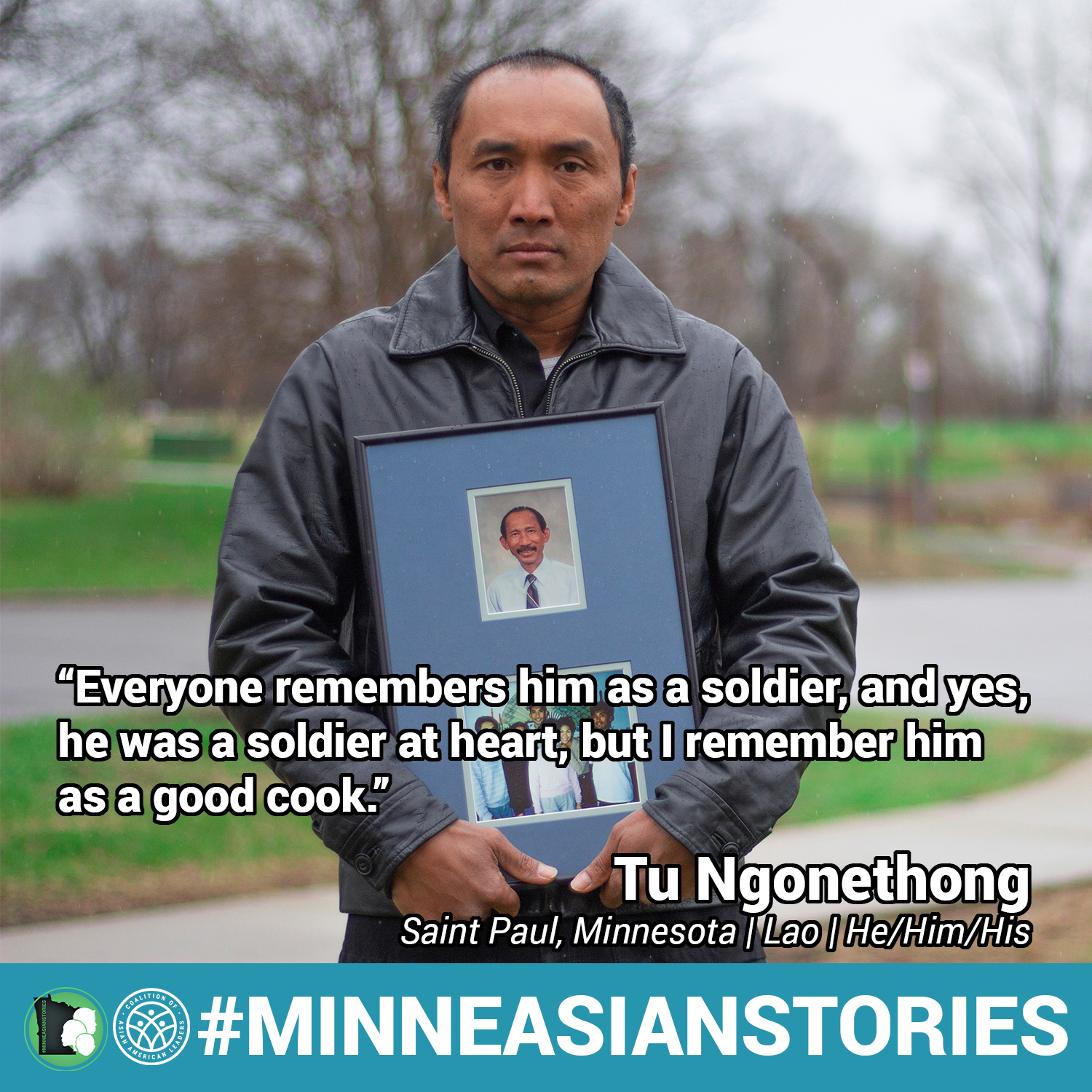
Everyone remembers him as a soldier, and yes, he was a soldier at heart, but I remember him as a good cook. He made a lot of food that I enjoyed. I wish that I would have inherited that talent from him. He was from southern Laos and he made very good pus pus (raw fish with spice). He really liked making this dish with clams and seafood. It’s one of the reasons why he stayed in Seattle. Looking back, I think he moved around a lot because nothing ever felt like home to him. He wanted to recreate home. Unfortunately, he never did.

Check out the rest of #MinneAsianStories.

Punk American, H*ck Yeah!!

Tri Vo

Eagan, Minnesota | Vietnamese | She/Her/Hers & He/Him/His

Billie Joe Armstrong is a musician who clocks in at 5’ 7” tall. He is recognizable for wearing a tousled mop for his dusty black hair — lazily stretching out from Armstrong’s head as though it were a small sun — coated by set in layers of soft black onyx. Tri Minh Vo, the person writing this piece, is also 5’ 7” with hair set by the glaze of black onyx.

Armstrong played a key role in ushering me as a Vietnamese 1.5 generation immigrant into the American life through one of America’s more notorious subcultures: punk — or punk rock music. Like black onyx, a stone said to transform negative energy and prevent the drain of internal energy, punk wasn’t merely a form of expression through sound. It was a way for the oldest immigrant child of three, who came from a country devastated only decades earlier by a war that has come to define both the country of Vietnam and its diaspora populations, to begin kindling the rage that he would need to be able to transform into nonviolent forms. Not only by telling his story, but more largely the story of the children of devastation who grow up at risk of blind assimilation into commodity utopias.

America is that utopia. And punk — through its ideal core as anti-imperialist and action-oriented lifeways against oppressive systems — is the light through which the falsehoods of any utopia maintained by power and violence would be exposed; and slowly, with great and collective persistence: disintegrated.

Are you tired of hearing about high stakes political ideologies yet? Tri has a track record of verbalizing her grand schemes to strangers, while forgetting that human beings tend to introduce themselves with less serious things like hobbies and interests first.

Tri has a troubled relationship with her identity. Tri goes by she/her pronouns, and yet presents as a male who can go by he/him pronouns. Jeff Rosenstock and John Darnielle’s music helped her stay buoyed through different stages of her adult life. She has made more meaningful relationships in the past half year since graduating from college, in May, 2018, than when she was in college. Tri wants changes within institutions. Tri wants changes outside of institutions. Tri wonders how she can help various groups in the Twin Cities overcome the forces of segregation that keeps these groups from liberating themselves in coalition, rather than apart from each other.

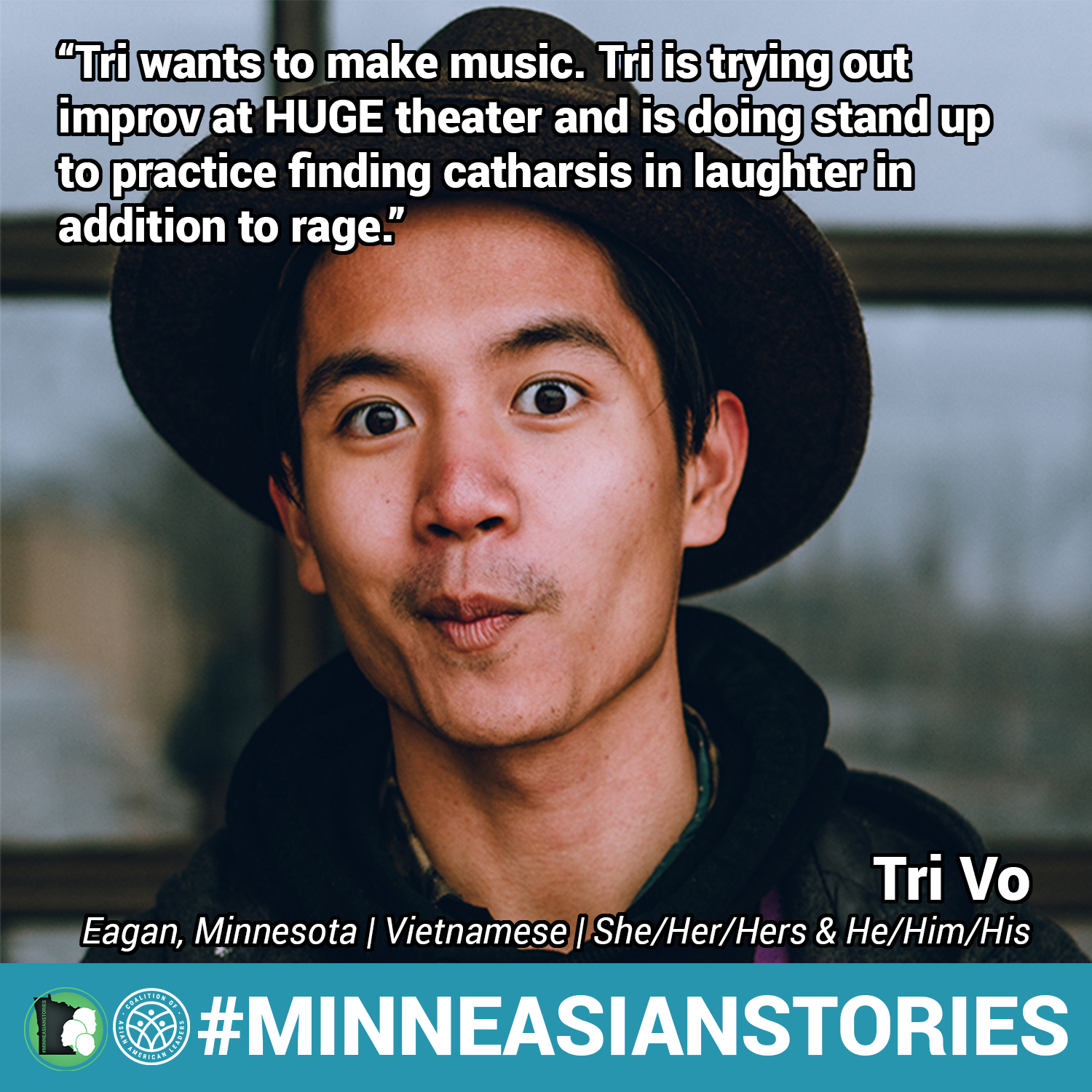
Tri only remembers that she is Vietnamese when others begin to assume another place that she is possibly from. Tri only remembers an upbringing in Eagan, Minnesota, and an education entrenched in St. Paul. Tri wants to make music. Tri is trying out improv at HUGE theater and is doing stand up to practice finding catharsis in laughter in addition to rage.

Tri is a Punk American. She is 5’ 7” tall with hair like black onyx. She will transform who she is inside so that she may have the right power to transform the world outside.

Check out the rest of #MinneAsianStories.

Making Lefse, the Korean Way

Stephanie Z

Minneapolis, Minnesota | Korean/Mixed Race | She/Her/Hers

I grew up in northwestern Minnesota outside of a very small town of about 300 people named Hendrum. Growing up as a biracial child; a Korean immigrant mother and a White dad made for an interesting mix of cultures and experiences – particularly during the 80s and 90s in rural Minnesota.

To be blunt, there were not a lot of people who looked like our family. My mom took pride in our Korean heritage and instilled a lot of those values in my sister and me growing up. At the same time, my family also embraced a lot of the unique northwestern Minnesota cultures, inherited from folks who have lived there for generations. In this part of Minnesota, families primarily came from Scandinavian ancestors. We learned how to count to ten in Norwegian and celebrated Norwegian Independence Day, Syttende Mai. Overall, during my childhood I felt like I straddled two different cultures – Asian and Scandinavian – including making and appreciating their respective traditional foods.

A lot of traditional Scandinavian food has become synonymous with what many would identify as holiday foods and Minnesota traditions. I grew up in a family that made an intentional choice to keep up our Korean culture but also to explore the community we were a part of. That’s how my mom learned to become an amazing lefse maker. Lefse is a traditional Swedish and Norwegian flatbread. In Hendrum, you could buy them in the grocery store, but many people still make it from scratch.

Food and the process of making food is where I see my two cultures coming together – the care that you put into the food is universal. It’s how most kids grew up; you just watch, learn, and experience. Over the years mom made friends who came from Norwegian heritage. She watched them make lefse and eventually said, “Hey! I can do this, and I think I can do it well.”

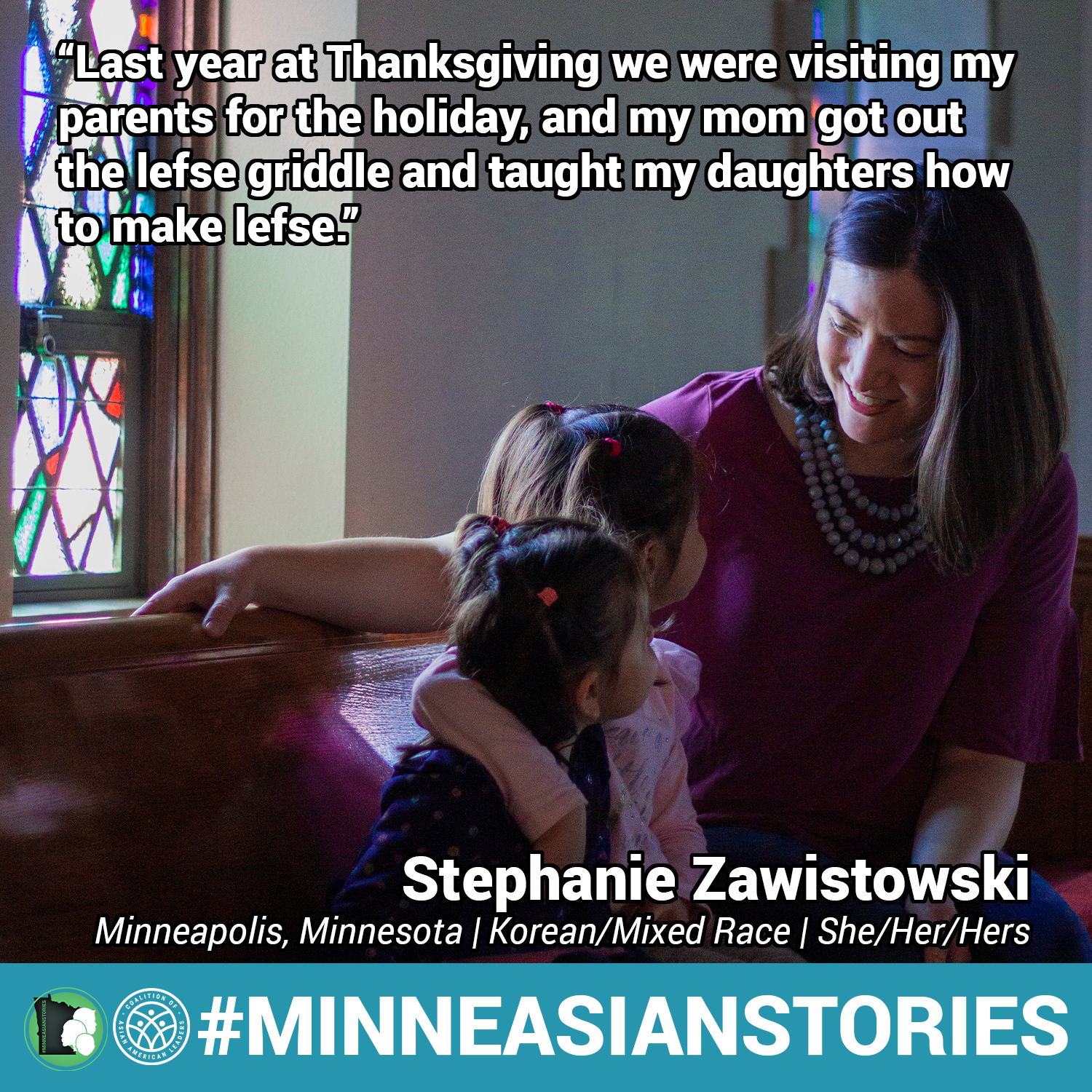
Last year at Thanksgiving we were visiting my parents for the holiday, and my mom got out the lefse griddle and taught my daughters, who are three and five, how to make lefse. It struck me as I watched my mom pass on her experience to my daughters that food and the process of making food is where two cultures can come together — the care that you put into the food is universal.

When we visit my parents during the holidays, it’s common that we’ll have lefse, krumkake, rosettes, other scandinavian holiday treats served alongside bulgogi, kimchi, and bibimbap, as well as the traditional holiday fixings of turkey, mashed potatoes, and green bean casserole. That’s what our holiday table looks like. This table is a great example of my life in Minnesota; growing up in a rural part of the state and being a biracial family. You just take it all in, and it becomes a part of you.

Check out the rest of #MinneAsianStories.

Making Peace With Guilt

See Moua Leske

Marshall, Minnesota | Hmong | She/Her/Hers

Last spring, I sought out a chiropractor. He did a complete scan on me and read the list of stressors in my life. It was no shock that “guilt” was on top of the list. As the oldest Hmong daughter, I had wife, mom, sister, and last but certainly not least, daughter guilt. I’m sure every Hmong son or daughter feels some guilt their parents pile on them, some may be on a daily basis.

You don’t visit as much as they’d like you to, so they remind you of the time they crossed the Mekong River with you as a baby strapped to their backs while soldiers shot at them. You forget to do the dishes, so they remind you of the time they packed all that they had and boarded a plane to a new country, so you wouldn’t have to sleep on a dirt floor hut and have a chance for a better life. You don’t give your parents money to send to relatives back in Laos, but they find out you took a trip with your family, so they remind you of all the times they worked in the hot fields in Laos in order for you to have rice to eat. My mother reminds me constantly of how grateful I should be to be alive and to be where I am today.

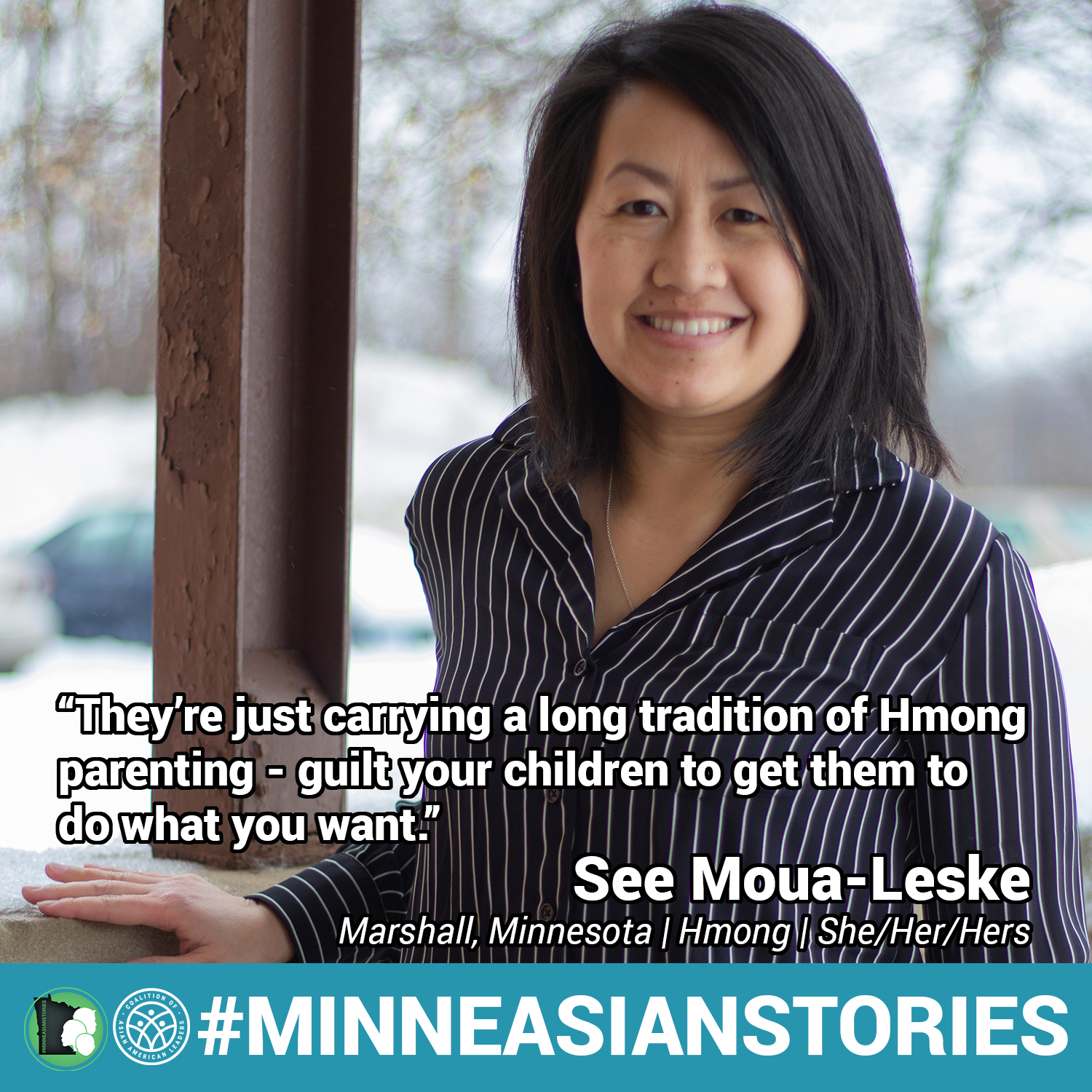
I am grateful to my parents for everything they’ve done for me, but as I raise my own child, I realize I have to also not let this guilt manipulate me. Everything my parents did, they did out of love. I shouldn’t feel guilty for it, even if they use it against me at times. They’re just carrying a long tradition of Hmong parenting – guilt your children to get them to do what you want.

In Hmong culture, many parents don’t show affection through affirming words, quality time or physical touch. Growing up I never heard “I love you,” nor did I experience any kind of physical touch, and there was no such thing as quality time. There was always too much work to do to just spend time with each other. The way Hmong people show love is through acts of service and gifts. My parents brought my siblings and I to the United States in the summer of 1986, and I will always be grateful for the courage they had. I have shown my appreciation in different ways, even though it may be in different forms than my parents are used to. The guilt was and will always be present, but I have mostly made peace with it.

Check out the rest of #MinneAsianStories.