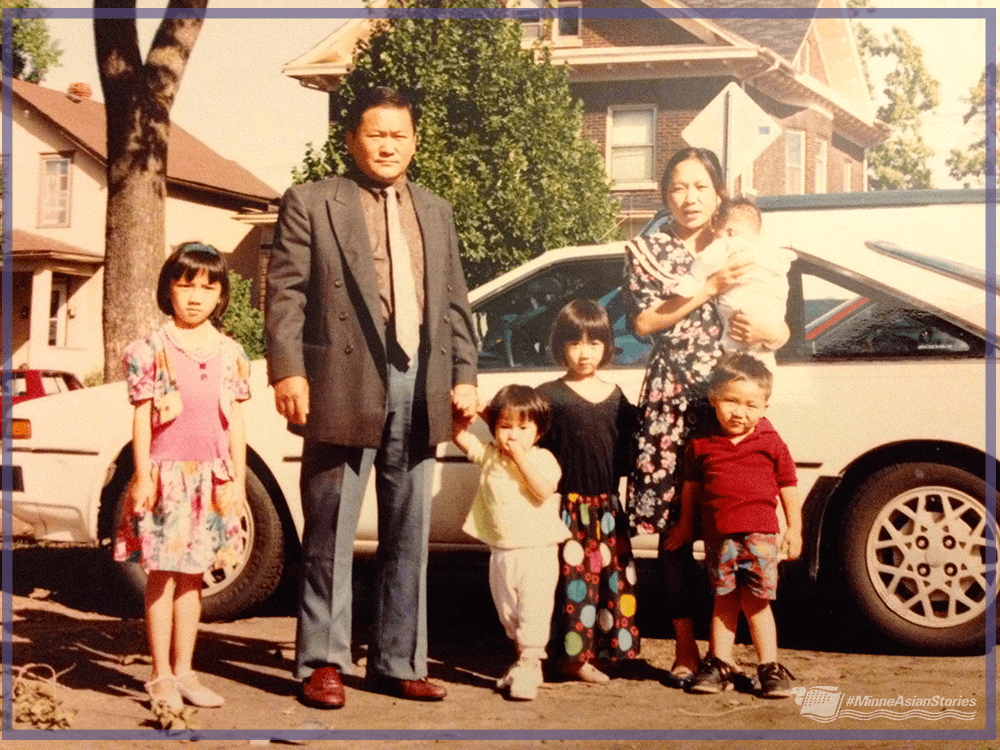
Dad’s Hmong Daughter


By Doua Yang, West Saint Paul

As a Hmong woman, I always questioned why I had to fit into the societal mold of high expectations and unrealistic standards. I grew up seeing women being punished or shamed for not serving others. They were silenced if they stood up for themselves. Was I born to serve? Was I born with no voice? Was I born to feel guilty and shameful every time I did not fulfill my obligations as a Hmong woman? For many years, I felt angry and confused. I was pushed past my limits, and told to be patient and strong. I was taught to give and give, and never to ask for anything in return. I was tired. I was taught I should be selfless, obedient, domestic, and desirable. I was drained. I was on autopilot trying to please, cater, and never disappoint. I was exhausted. Was I ever going to be “good” enough?

I felt angry. My anger soon turned into resentment. I resented my dad for being the man of the house but carrying unjust traditions. I resented my dad for being progressive, yet so closed-minded. I resented my dad for not sticking up for me and believing in my ability. I resented my dad for telling me no because I was born a girl. I loved and respected my dad, yes, but I resented him for making me feel powerless, voiceless, and at times worthless.

When I graduated from college, chin up because I was the first in my family to do so, I had this mentality that I had proved my dad wrong. I still felt bitter. Expecting a simple nod, I was surprised when he turned to me and said, “Daughter, I couldn’t see you clearly on stage because of my eyesight, but I am happy to see you standing here today celebrating your accomplishments. You have worked very hard. Mom and I are very proud of you.” I stood still for a few minutes trying to comprehend. I didn’t realize I had been waiting for those words my entire life to forgive and understand.

I didn’t prove my dad wrong, I proved society wrong. My dad raised me to be the Hmong woman society wanted me to be: obedient, submissive, and domestic, but I turned out to be the Hmong woman he wanted me to be: strong, resilient, outspoken, vulnerable, and independent.

A year later, my father passed away. As I sat by his side for the last time, I knew deep down inside: I am enough. I am important. I am worthy. I am the best Hmong woman, daughter, and sister that I was raised to become. Thank you, Dad.

Check out the rest of #MinneAsianStories.
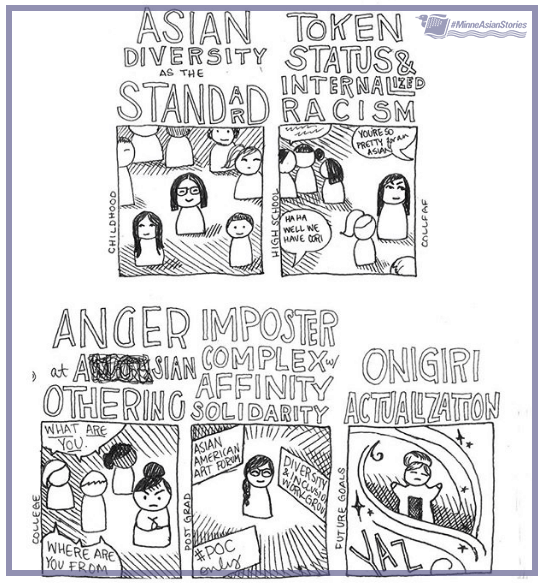
Indecipherable Swarm of Asians

Cori Lin, Minneapolis

When I was growing up in the suburbs of Chicago, I didn’t go to Asian gatherings. I went to family gatherings and church gatherings that were comprised of all Asians, but we weren’t there because we were Asian. We were there because we loved Jesus, or just because we were related. We rarely talked about Asianness, Japaneseness, or Race. We just were. Beyond church and family, I would actively avoid Asian spaces or groups at school, preferring to hang out with the nerdy white kids. I was constantly afraid of being erased in the minds of my white peers, blending into an indecipherable swarm of Asians, being seen as a stereotype rather than an individual.

Moving to Minnesota, learning and growing, I’ve started to love myself and my Asianness more fully. I struggled finding belonging in the mostly white non-profit sector of MN, and I found acknowledgement, understanding, and commiserating with other Asians, who are often looking around the room desperately trying to find a face that looks like theirs. While I rarely meet fellow Japanese or Taiwanese Americans, the Asian community has been unabashedly welcoming. I think they feel similar waves of frustration and insecurity emanating off me. Becoming friends with Minnesota Asians from many backgrounds, I started to see similarities in our horror stories (re: experiences of racism and prejudice) and perspectives. I recognized some of my scars in theirs, and was even given names for them (microaggressions, whitewashing, tokenism). Back home in the suburbs of Chicago there are many more Asians that are similar to me, but here in Minneapolis I found connection.

Check out the rest of #MinneAsianStories.
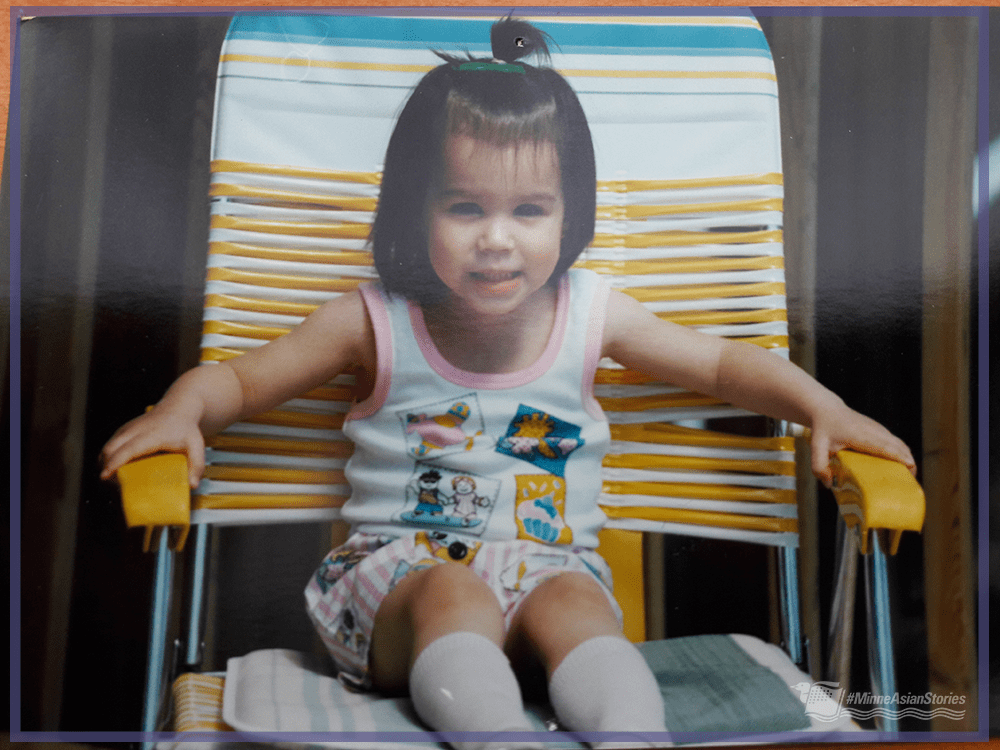
Really, You’re Asian?

By Aara Johnson, Blaine

I thought that eating half a plate of white rice with a few vegetables and fried fish was normal. I thought my slimy, red hands after peeling shrimp was normal. My mother’s stick-straight black hair wouldn’t shake much as she laughed to her Filipino shows—ones I never understood. I thought it was normal to have turkey, mashed potatoes, and green beans at Thanksgiving or Christmas. It did not phase me as a child that my mother was the only Asian person at these holiday family parties on my dad’s side. I have always called Minnesota home. And, I have always said that I grew up Asian because my mother was the main child-rearing parent. But, different experiences have challenged my dual-identity.

Every first day of school or a new class, I knew when my name was coming up. I could see the struggle in my teacher’s voice when they tried to pronounce it. “Aah-rah?” “Area?” “Aria?” I’d joke and tell them not to worry because my last name—Johnson—made up for my first name: Air-a. I’d always get questions, too, like “what are you” or be met with disbelief when I told them I was Asian—like I was lying or something. I visited “the motherland” for the first time when I was four, the time I first remember visiting was in 7th grade. Because I didn’t know tagalog, I studied from a book to have a decent handle on some vocabulary and phrases. But, the fast-paced conversation flew through my ears without comprehension. And still does. The next four times I visited felt like home even though I couldn’t fully communicate: passing the colorful, smoky jeepneys or the small corner shops selling beer by the bottle. Or, feeling the hot, sticky sun constantly without the refuge of air conditioning.

Whenever I’m in a group of white folks, I tend to feel—deep down—a sense of disconnect. I used to wonder if I were a “real Minnesotan” because I didn’t have a cabin up north or spent my weekends at hot dog and burger barbecues. When hanging out with other people of color, I felt more comfortable and realized how white I wasn’t. But then, when I was at Filipino parties, or even other pan-Asian events, I’d feel the same disconnect but from the opposite perspective. Although I recognized and enjoyed tangy pancit, crunchy lechon, and smooth leche flan, I sometimes feel like some white girl visiting The Philippines and appropriating the culture. Like I can’t actually claim it as my heritage even though it runs through my veins.

I understand my struggle as racial impostor syndrome: feeling fake or inauthentic in an identity. I’m realizing that I’m living in a multiracial society on an individual level. I embrace both parts of myself and double the fun. My personal struggle to live in self-harmony helped me appreciate the progress toward diversity and inclusion in society.

Check out the rest of #MinneAsianStories.
Giving Ourselves Permission To Be

By Boonmee Yang, Roseville

Before the internet, I genuinely believed I was the only gay Hmong boy in the entire Midwest. Gays existed in big cities like LA, San Francisco, Chicago, and New York City, but not here. Not in the Twin Cities. After I succumbed to this lonely belief, my life became like the fists in the photo: holding onto a tense secret and closed off. This loneliness was different from the loneliness of being one of few Asian students at my all-white high school. Outside of school, I knew where to find other Hmong kids, but not queer Hmong kids. This loneliness had a hunger that began chewing at my core identity, which encompassed everything from being Hmong, American, Christian. Desperate to conform to societal and religious norms, I spent countless nights praying for God to miraculously zap me with a bolt of lightning that would turn me straight. Make me find girls attractive, I’d pray, so I can be and feel like all the other boys. Be accepted. Feel normal. Feel less lonely.

But lightning never struck.

Despite plenty of rainstorms raging over my house (and within myself) throughout middle to high school, my prayers never got me closer to where I needed to be. My attraction for boys only grew, as did the shame and self-hate. Self-hate got exhausting. I began praying for self-acceptance instead.

That made a difference.

Slowly I began to embrace and accept what made me different from other boys. I began appreciating the perspective I’d gained. Being different had allowed me to empathize with other marginalized communities: women in the church, society, within the Hmong community, people of color in white America, and LGBTQ people like me. Loneliness turned to activism and advocacy against oppressive systems that create fear, self-doubt and hate in people born the way they are. People like me. Young queer Hmong boys like me who only wanted to belong.

Within the Twin Cities, we’ve seen wonderful community groups and organizations, such as the now defunct SOY (Shades of Yellow), rise up to meet the needs of Asian LGBTQ members and embolden their identities. But on the journey to accept myself, I also discovered that spending so many years trying to re-carve my innermost being left me with residual feelings of shame that still require deconstructing. Though I’ve since come out, I still get uncomfortable holding my partner’s hand around the cities here, or even when we’re in Castro, San Francisco. To this point, Alan Paton strikes it head-on in one of my favorite novels, “Too Late the Phalarope”, “When a deep injury is done to us, we never recover until we forgive.” While gaining self-acceptance was the first step to healthy living after decades of self-hate, I’ve been working on self-forgiveness for an even more enriched life that the 15-year-old me in the photo deserves.

For those seeking self-acceptance and forgiveness, or to belong, know you are not alone. Send out your satellite calls. We are listening.

Check out the rest of #MinneAsianStories.
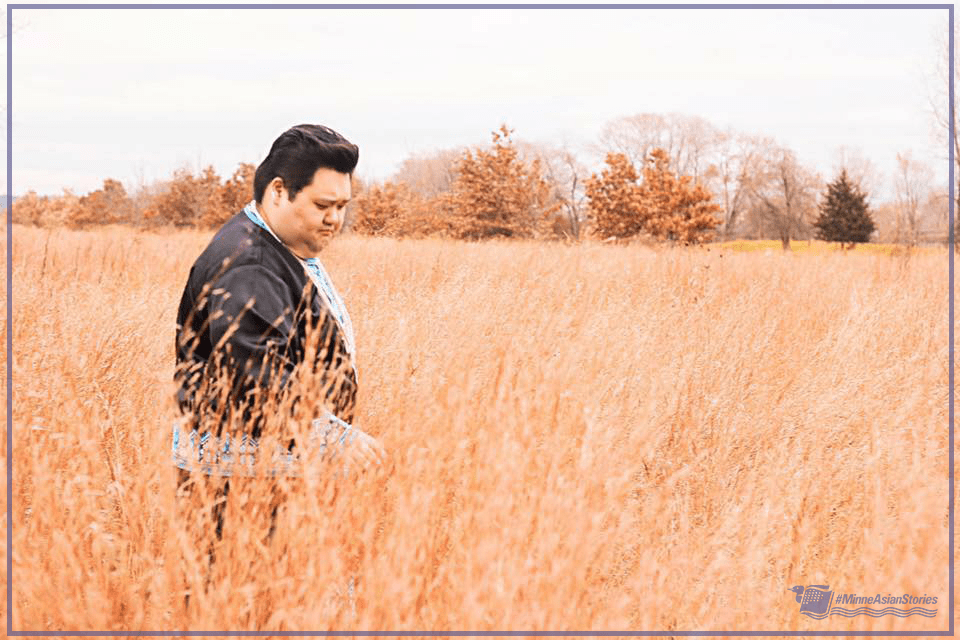
The Fabric Fields

By Christopher Xiong, Brooklyn Park

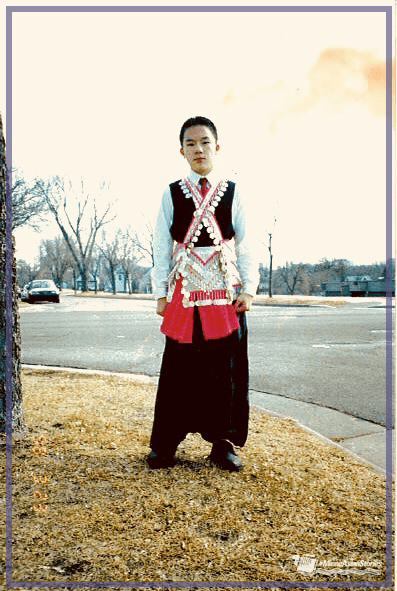
The picture is of me in Hmong clothes surrounded in a field of wheat, to me it describes growing up as a first generation Hmong-American, I was stuck between two worlds, one world taught me that I have to be ‘Americanized’ adapting the American ways, but there’s this other world that reminds me to keep my roots and identity as a Hmong descent.

There was a time when I didn’t appreciate who I was. When I was in elementary school I’d get asked by a lot of other kids about who my people were. I replied “Hmong” and most of them would reply back “is that another word for Chinese?” From kindergarten to 4th grade, I didn’t want to mention or say much about my culture and heritage because I felt like my story wasn’t as interesting as the other kids who would share about their ancestry being from Ireland, Germany, Austria etc. But being the only Asian kid of Hmong descent really made me an outcast of not belonging anywhere.

I would come home after school and question my father of “why aren’t our people as interesting as others?” He would give me his confused glare and talk with me about the history of the Hmong and why we are here in the United States, the struggle of our people through many centuries and wars to be where we’re at. I started to ask more questions. The more I heard, the more I asked.

The Vietnam War was taught to us in elementary but it was only focused on Vietnam and a little on Cambodia but not Laos. When Junior High came around and we started to learn about more about the Vietnam War, there was a section about the war in Laos and our teacher started to talk about the Hmong’s involvement that was similar to what my father spoke of when he told me about the war. I started to listen more at family gatherings as the elders would gather around, I would ask my dad to buy a lot of Hmong history documentaries for me to watch and books to read.

As I grew older, Hmong history started to become more interesting, as more stories are being revealed by our elders. Minnesota is a state that appreciates the sacrifices of our veterans and people. I pursued my education at the University of Minnesota – Twin Cities in both Political Science and History, but History was the major I first declared due to my love for stories that have been shared or has yet to be discovered. Like my Hmong clothes, every day the sewing of the fabric becomes more brighter and more artistic with stories of my life and like the wheat field I will always search for more of the stories that have yet to be discovered.

Hmong may not have a country, but what’s unique is that a place will never describe my people, but it’ll be my people that defines the place they call “Home.” Minnesota will always be home.

Check out the rest of #MinneAsianStories.

21 Cultural Nonprofits Across Minnesota Receive Grants to Strengthen Their Organizations

For immediate release

January 26, 2018

St. Paul, MN, January 26, 2018 – In the 2017 legislative session the Coalition of Asian American Leaders (CAAL) formed a broad base of over 40 cultural and infrastructure nonprofits and secured $1 Million for the Nonprofit Infrastructure Grant Program. The program is being administered by Propel Nonprofits through the Department of Employment and Economic Development (DEED).

“We led the creation of this program because in our survey of Asian American nonprofits we learned that many were not receiving the kind of investments they needed to become strong. Even though many were providing some of the most important services to meet the needs of their community they most often had the most fragile infrastructure in the sector. That’s unacceptable given our state’s commitment to small businesses, diversity and addressing racial inequities,” states Bo Thao-Urabe, CAAL’s Network and Executive Director.

CAAL found similar patterns of organizational instability from lacking investments in other people of color and Indigenous communities. Given that information CAAL worked with their leaders and legislators to address the challenge, eventually reaching out to Propel Nonprofits to be the implementation partner given their expertise in building nonprofit infrastructure.

Yesterday’s announcement of the 21 organizations from across Minnesota selected by Propel Nonprofits moves the work of ensuring cultural nonprofits strengthen their organizations to become strong employers with effective programs that meet the needs of Minnesota’s diverse communities forward.

KaYing Yang, CAAL’s Director of Programs and Partnerships reflects that, “We know that when work across communities we all benefit. The coalition worked hard to build bipartisan support in the Minnesota Legislature. The 21 groups selected and the people they serve will benefit from the financial support.”

Yang adds, “This is only the tip of the iceberg. More than 180 applications were received, indicating the great need to grow this program for other deserving organizations.”

“We believe this first group will show that when organizations from communities of color and Indigenous communities are strengthened they will help make Minnesota better. CAAL plans to continue working to ensure that Minnesota leverages the community and linguistic assets of cultural communities to strengthen our national and international economic competitiveness which often reside within the nonprofits in our community,” Thao-Urabe said.

For more information contact: Ms KaYing Yang, (808) 492-3630 mobile, KaYing@caalmn.org

Press Release – 21 Cultural Nonprofits Receive Grants to Strengthen Organizations

Press Release: Minnesota’s ESSA plan needs to be more ambitious for English Learners

The Minnesota Department of Education (MDE) released its Every Student Succeeds Act (ESSA) Minnesota state plan on August 1st and will allow a 30 day public comment period. The Coalition of Asian American Leaders (CAAL) and Minnesota Education Equity Partnership (MnEEP) compared the State plan to their recommendations they offered earlier this year in their policy brief. Read the full press release.

Bo Thao-Urabe, CAAL’s Network Director states, “We are happy to see ESSA’s focus on English Learners, who make up some of the largest student growth populations in Minnesota’s school districts. We urge community members to respond to the state plan and participate in the MDE’s regional meetings. For too long, parents and students have felt stigmatized when placed in EL programs. This is an opportunity for them to offer insights and innovative ideas to strengthen programs that serve their children to succeed academically.”

“It is important to have authentic voices for determining public policy that works well for the people,” shared Carlos Mariani Rosa, MnEEP Executive Director.  Mariani Rosa further adds, “We are pleased to support emerging multilingual learners to shape laws that help them to achieve high levels of academic proficiency in Minnesota.”

The Minnesota Multilingual Equity Network’s policy brief provides important background information about Minnesota’s English Learners (ELs), and the state’s alignment with the federal ESSA Law. It also provides seven recommendations on what is needed to achieve high academic outcomes for ELs:

  1. Implement strong and culturally responsive family engagement to meet evolving and diverse educational needs
  2. Provide academic native language curriculum and courses to support rigorous literacy development
  3. Use a robust and multidimensional calculation of growth toward English language proficiency
  4. Develop consistent, objective criteria and school practices for EL program entry and exit
  5. Use baseline data from recently arrived ELs to establish and maintain high academic standards
  6. Prioritize support for early development of dual language learners
  7. Strategically strengthen professional development and programs to support ELs in low-performing schools

To download the policy brief, please visit mneep.org or caalmn.org. Read the full press release, which includes links to the side-by-side comparison of the plan with our recommendations .